
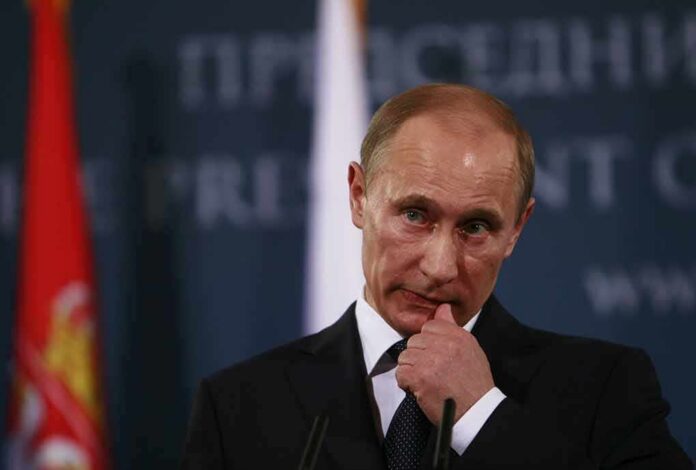
Russian President Vladimir Putin says Ukraine “opened Pandora’s box” by bombing Russian oil refineries, and he’s now promising to strike back at Ukraine’s “most sensitive economic sectors.”
Story Snapshot
- Putin publicly blamed Ukraine for escalating the war by targeting Russian economic infrastructure.
- Ukraine has spent the summer of 2026 hammering Russian oil refineries, ports, and warehouses with drones.
- A Ukrainian strike forced Russia’s Orsk refinery to shut down completely, with repairs expected to take up to six months.
- Kyiv says the strikes target facilities that fund and supply Russia’s war machine, not random economic targets.
- The exchange signals a war with no end in sight, raising fresh questions about how long America keeps footing the bill.
Putin’s Warning Escalates War Rhetoric
Russian President Vladimir Putin said in comments published August 22 that Ukraine “opened this Pandora’s box itself” by hitting Russian economic targets. He warned Kyiv to “expect a response targeting your most sensitive economic sectors”. It’s a blunt threat from a man who has spent four years grinding through Ukrainian cities. Now he’s promising to make ordinary Ukrainians pay a heavier economic price for Kyiv’s own campaign against Russia’s oil money.
Putin’s framing puts the blame squarely on Ukraine for escalating the fight beyond the battlefield. That’s a familiar tactic from a leader who invaded a sovereign neighbor in the first place. Still, the facts on the ground back up at least part of his complaint: Ukraine really has ramped up long-range strikes deep inside Russian territory this summer, hitting targets Moscow once considered untouchable.
Ukraine’s Drone Campaign Hits Russian Refineries Hard
Ukraine’s military said it attacked the Orsknefteorgsintez oil refinery in the city of Orsk on August 11, and the plant was forced to shut down completely two days later. Russia’s regional governor warned repairs could take up to six months, threatening fuel shortages for ordinary Russian drivers. It’s one of dozens of refinery, port, and pipeline strikes Ukraine has carried out since early summer, stretching from the Baltic Sea to the Ural Mountains.
Ukraine also struck the Ilsky and Syzran refineries, the Vysotsk oil terminal on the Baltic, and Russia’s largest refinery in one of the deepest strikes of the war. Russian officials confirmed fires at multiple sites. The pattern shows a deliberate strategy: cripple the fuel and revenue streams keeping Moscow’s war machine running, without waiting for a battlefield breakthrough that may never come.
Kyiv Says Strikes Target War Machine, Not Civilians
Ukrainian President Volodymyr Zelenskyy has defended the campaign as self-defense, not reckless escalation. He said he ordered intelligence and military units to “act in advance against the facilities the Russians use to scale up the war”. Zelenskyy also said Ukraine obtained internal Russian documents showing the strikes were being “felt painfully” in Moscow, a claim meant to prove the pressure campaign is working.
Zelenskyy described one strike on port oil infrastructure as targeting “revenue that generates money for Russia’s war,” distinguishing it from attacks on civilians. Reuters reporting backs this framing, noting Kyiv casts the campaign as an effort “to deprive Russia of resources to fund its military”. Whether Putin accepts that distinction is another matter entirely, and his threatened retaliation suggests he does not.
Escalation Raises Stakes for American Interests
Russia has already answered with its own economic targeting, striking Ukraine’s Izmail and Odesa ports and damaging a civilian vessel while injuring four people. Russian missile attacks have also mostly hit residential areas, according to reporting on Moscow’s response to Ukraine’s refinery campaign. Neither side shows any sign of backing down, and Putin’s latest threat suggests Russia intends to widen its target list even further.
This week in #Ukraine – Ukrainian forces sustained long-range strikes on Russian oil infrastructure, ports, and logistics hubs while making local advances near Kostyantynivka, Oleksandrivka, and Orikhiv. Russia conducted repeated large-scale drone and missile strikes on Ukrainian…
— Greyskull (@FreudGreyskull) August 23, 2026
Conservative voters who have watched Washington pour billions into this war for years have every reason to ask where it ends. Putin’s “Pandora’s box” line is designed to shift blame onto Kyiv, but it also confirms Russia plans more strikes, not fewer. A war with no clear off-ramp means more risk, more cost, and more pressure on American taxpayers to keep bankrolling a conflict thousands of miles from home.