
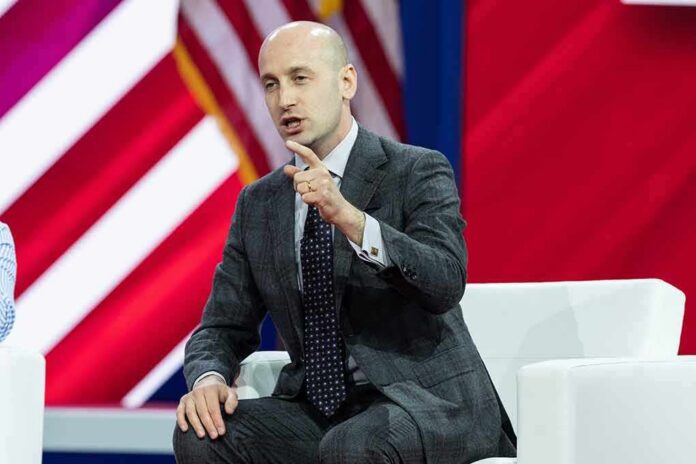
President Trump named Stephen Miller the 33rd White House chief of staff, signaling a sharpened push to execute the America First agenda now.
Story Highlights
- Trump elevated Miller from deputy chief of staff and set the start date for November 9, 2026.
- Susie Wiles departs the role and will shift to the Trump political operation, with public thanks from Trump.
- The White House praised Miller’s record alongside Trump and framed the move as strengthening execution.
- Major outlets tied the timing to post‑midterm politics and described Miller as a hard‑line policy hand.
Trump Confirms Appointment And Timeline
President Trump announced Stephen Miller as the new White House chief of staff and set his start for Monday, November 9, 2026. The White House release identified Miller as the 33rd person to hold the job and confirmed he would succeed Susie Wiles. Trump described Miller as one of his most trusted advisers and praised his political skill and management. The announcement placed Miller’s promotion within his ongoing service in the administration as deputy chief of staff.
Trump also addressed the transition for Susie Wiles. He thanked her for an outstanding run and said she would move to the Trump political operation. That clarification showed continuity for a veteran aide while marking a clear shift in West Wing leadership. The White House message focused on experience and trust, placing Miller close to the center of daily decision flow and tasking him with coordination across policy and communications.
What Miller’s Elevation Means For Governance
The chief of staff manages access to the president and drives follow‑through across agencies. Elevating a deputy chief of staff who has worked with Trump from the start tightens control and shortens learning curves. The White House said Miller helped deliver gains on crime, border security, and fraud enforcement, though the release did not include the underlying data. The role gives Miller power to schedule, filter issues, and press agencies to meet deadlines aligned with Trump’s agenda.
The timing after the midterm elections fits a common pattern. Presidents often reset staff to sharpen focus, speed up decisions, and push implementation. Trump’s choice sends a signal about tight execution on key promises many conservatives care about: border enforcement, public safety, energy production, and a lighter regulatory load. The move places a trusted adviser between Trump and the bureaucracy, which can reduce drift and curb slow‑rolls that have stalled policy in the past.
How Media Framed The Move And What To Watch Next
Major outlets highlighted Miller’s reputation from past immigration fights and cast the change as a post‑election shift. Reuters and the BBC emphasized the political context and labeled Miller a hard‑line policy figure. That framing will shape coverage, but it does not alter the confirmed facts of the appointment, the start date, or the stated transition for Wiles. The chief‑of‑staff role does not require Senate confirmation, so the White House holds the initiative on pace and process.
Trump faces criticism for ‘dangerous’ Stephen Miller appointment as White House chief of staff
Democrats and Republicans blast promotion of ‘xenophobe’ who led administration’s immigration crackdown in wake of US midterm electionshttps://t.co/lTR64fClUJ— dave lawrence 🐟🐟🐠 (@dave43law) November 7, 2026
Conservatives should watch for clear signs of tighter policy execution. Early markers include faster agency deadlines, stronger coordination with border and justice officials, and visible follow‑through on spending restraint and energy expansion. The White House can bolster confidence by publishing schedules, directives, and measurable goals. That would match the promise of firm management with transparent milestones. For now, the facts are set: Miller takes charge Monday to drive the next phase of Trump’s America First push.
Sources:
theamericanconservative.com, whitehouse.gov, reuters.com