

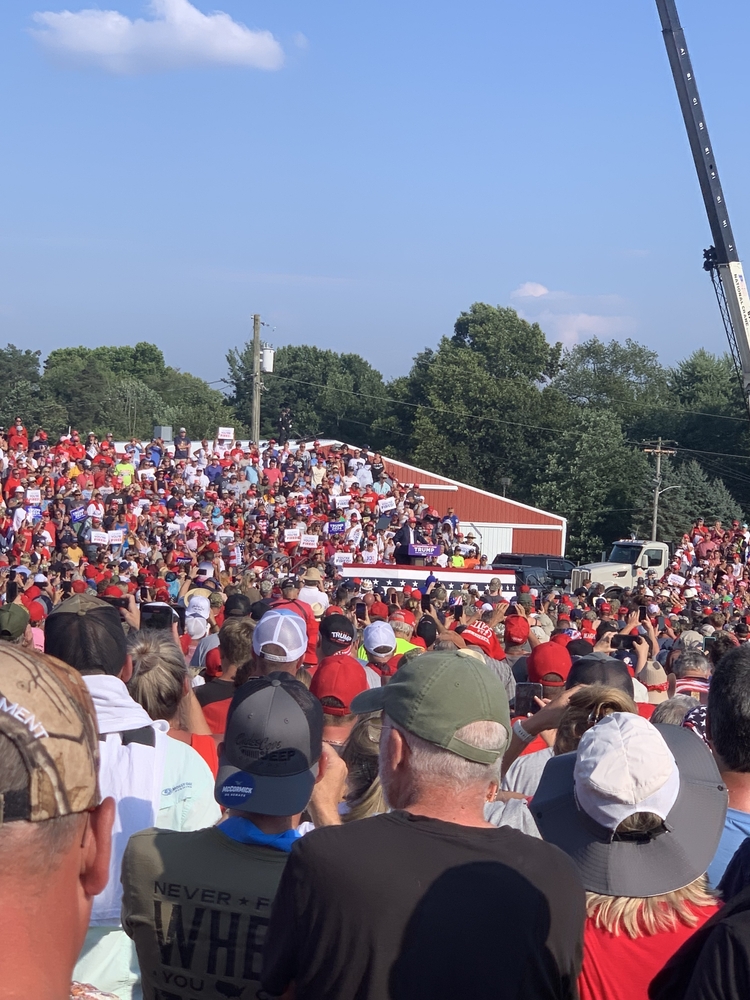

Pre-Shooting Warning Buried by Redactions
A single radio call about an “unknown male acting suspiciously” may become the most damning detail of the Butler rally shooting—not because it existed, but because it seems to have evaporated into redactions and delays.
Story Snapshot
- Judicial Watch forced the first FBI Butler-specific document release through FOIA litigation: 37 heavily redacted pages.
- Those pages describe law-enforcement radio warnings about a suspicious male before shots were fired at the July 13, 2024 Trump rally.
- Thomas Matthew Crooks fired eight rounds from a rooftop, grazing Trump’s ear, killing attendee Corey Comperatore, and injuring two others before a Secret Service counter-sniper killed him.
- The records expand the timeline of what officials noticed before the attack, while keeping key details hidden behind black bars.
The Butler timeline keeps pointing to the same question: who heard what, and when?
July 13, 2024 ended with a rooftop gunman dead and a nation asking how a presidential candidate could be shot at an open-air rally in Butler, Pennsylvania. The known facts are straightforward: a 20-year-old local, Thomas Matthew Crooks, fired eight rounds, struck Donald Trump in the ear, killed Corey Comperatore, and wounded two more attendees. The harder story sits inside the minutes before the first shot, where “suspicious” becomes the hinge word.
Judicial Watch says FBI records show radio warnings broadcast before the shooting about an “unknown male acting suspiciously.” That phrase matters because protective operations live or die on early recognition: a report, a relay, a response, then a physical interdiction. If the warning hit the air and no decisive action followed, the failure would not be theoretical. It would be procedural, measurable, and—if documented—accountable. Heavy redactions now make the timeline feel like a jigsaw missing the center.
FOIA warfare, not press conferences, produced the first FBI paper trail
Judicial Watch pursued records after alleging the FBI did not respond adequately to requests, then filed suit to compel production. The result: 37 pages, heavily redacted, including an FBI FD-302 dated July 16, 2024 that memorializes post-incident interviews and investigative steps. That narrow release matters less for what it contains than for what it signals: federal agencies often disclose sensitive operational information only under legal pressure, and usually only in fragments.
The conservative lens here isn’t about assuming sinister motives; it’s about insisting that government answers to the public, especially after catastrophic lapses. Transparency serves ordinary citizens first: the people who attend rallies, volunteer, stand in line, and trust that multiple layers of security communicate clearly. When disclosures arrive “years and a federal lawsuit” later, as Judicial Watch’s Tom Fitton argued, the delay itself becomes part of the story because it erodes trust in routine oversight.
Interagency protection fails at the seams, not at the center
Campaign protection blends Secret Service responsibilities with local police and specialized units, creating a chain where each link assumes another link has the problem covered. Local preparations reportedly included sniper teams and quick-response elements, yet Crooks still got to a rooftop and fired. That outcome fits a recurring pattern in complex operations: the center looks strong on paper, while the seams—radio traffic, threat triage, and jurisdictional handoffs—become the weak point.
The released FBI materials reportedly include not only the pre-shooting warning but also mundane investigative details: a flip phone seized and returned, neighbor interviews describing Crooks as “normal,” and even a business card found at the scene. Those details can feel like filler, yet they reveal how investigators reconstruct a suspect’s life after the fact—often discovering that “no prior derogatory information” is not the same as “no warning signs on the day.” The day-of operational picture is what the public still lacks.
Redactions protect methods, but they also protect mistakes
Redactions serve legitimate purposes: safeguarding sources, tactics, and ongoing investigative equities. The problem arises when redactions also hide the practical questions voters and citizens have a right to ask. What exactly did “acting suspiciously” mean in real time—loitering, scanning, climbing, carrying gear? Which agency first observed him? Who had authority to move on a rooftop contact? If those answers sit under black ink, the public’s only option becomes speculation, and speculation punishes everyone.
Congress tried to fill the vacuum by forming a House Task Force to investigate, a sign lawmakers recognized a credibility crisis beyond partisan reflexes. Task force work can clarify roles, timelines, and the moment-by-moment sequence that determines whether a warning becomes action. The American conservative standard for this kind of inquiry is simple: identify the failure point, fix the system, and resist the bureaucratic instinct to classify embarrassment as “security.” Competence is not optional in protective missions.
What accountability could look like without turning it into theater
Competent accountability would map three things plainly: the radio warning timeline, the response timeline, and the command-and-control structure that governed decisions at the perimeter and elevated positions. If local officers broadcast a warning, the record should show who acknowledged it and what action followed. If Secret Service teams acted but faced constraints, the record should show those constraints. If protocols existed but weren’t followed, leadership should explain why and how it will prevent repetition.
The Butler shooting also spotlights a cultural problem inside modern governance: agencies too often treat basic records as their property, not the public’s. Judicial Watch’s litigation strategy reflects a broader reality—citizens increasingly need lawyers to get answers about events they watched unfold live. That dynamic clashes with common-sense expectations of a free country. If government can’t explain how it handled a clear pre-incident warning, voters will assume the worst, even when the truth might be merely bureaucratic failure.
Butler’s lasting lesson will not be the footage of gunfire and chaos; it will be whether the system proves it can learn in daylight. The next release of records—less redacted, more specific—will decide whether Americans see a chain of preventable errors or a sequence of unavoidable events. Until then, every blacked-out line reinforces the same suspicion officials claim to be fighting: that someone knew, someone warned, and someone failed to act.
Sources:
https://fallon.house.gov/uploadedfiles/tf.finalreport.pdf
https://www.openrecords.pa.gov/Appeals/DocketGetFile.cfm?id=185324