The Watergate scandal remains the gold standard for government spying and abuse of power, yet no modern scandal has definitively surpassed it despite decades of political corruption and constitutional violations.
Story Snapshot
- Nixon’s 1972 break-in at DNC headquarters led to the first presidential resignation in U.S. history after White House tapes exposed his cover-up role
- Over 40 officials convicted in the scandal that birthed the “-gate” suffix now applied to every political controversy
- The scandal emerged from Nixon’s paranoia over re-election security and Pentagon Papers leaks, creating the illegal “Plumbers” unit
- Watergate set the benchmark for presidential abuse of power, yet spawned intelligence reforms that subsequent administrations have systematically eroded
The Break-In That Changed America
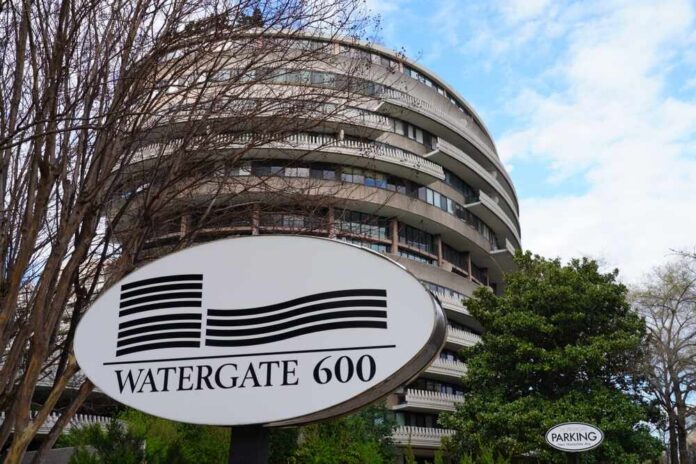
On June 17, 1972, five operatives connected to President Richard Nixon’s Committee to Re-elect the President were arrested inside the Democratic National Committee headquarters at the Watergate complex in Washington, D.C. The burglars, including security coordinator James McCord, were caught attempting to plant listening devices and photograph documents. The botched operation traced directly to Nixon’s re-election campaign through operatives G. Gordon Liddy and E. Howard Hunt, who planned the break-in under the “Gemstone” intelligence-gathering plan approved by former Attorney General John Mitchell.
Cover-Up and Constitutional Crisis
Nixon’s administration orchestrated an extensive cover-up involving hush money payments to the burglars and obstruction of justice that would ultimately seal his fate. White House Chief of Staff H.R. Haldeman and Counsel John Dean coordinated the cover-up, with Dean later testifying that Nixon knew about the operation by September 1972. The Washington Post’s Bob Woodward and Carl Bernstein exposed critical links, including a $25,000 check traced to one burglar from a secret campaign fund. Nixon wielded executive privilege to resist investigations, culminating in the October 1973 “Saturday Night Massacre” when he fired Special Prosecutor Archibald Cox, triggering the resignations of Attorney General Elliot Richardson and Deputy William Ruckelshaus.
The Smoking Gun and Resignation
Senate hearings in July 1973 revealed the existence of Nixon’s secret White House taping system, becoming the scandal’s turning point. The Supreme Court ruled unanimously on July 24, 1974, in United States v. Nixon that the president must release the tapes, rejecting his executive privilege claims. The August 5, 1974 release of the “smoking gun” tape confirmed Nixon’s personal involvement in obstructing the FBI investigation just days after the break-in. Facing certain impeachment, Nixon became the first U.S. president to resign on August 9, 1974, leaving a legacy of distrust that fundamentally altered American politics.
Enduring Impact on Government Accountability
Watergate produced over 40 convictions of high-ranking officials, including Mitchell and Haldeman, who served prison terms for their roles in the conspiracy. The scandal drove campaign finance reforms through the Federal Election Campaign Act of 1974 and influenced intelligence oversight measures like the Foreign Intelligence Surveillance Act of 1978. Gerald Ford’s controversial pardon of Nixon further eroded public trust in government institutions. The scandal established Watergate as the permanent benchmark for political corruption, yet its lessons about unchecked executive power and government surveillance remain troublingly relevant as subsequent administrations have expanded warrantless spying programs that would have made Nixon’s “Plumbers” unit seem amateurish by comparison.
Why No Scandal Has Topped Watergate
Historians consistently rank Watergate as the defining American political scandal because it combined presidential-level authorization of illegal surveillance, systematic abuse of power, and obstruction of justice that forced a resignation. The scandal emerged from Nixon’s 1971 formation of the “Plumbers” unit to stop leaks following the Pentagon Papers release, revealing how national security concerns became pretexts for political espionage. Despite rhetorical claims of “bigger than Watergate” scandals in subsequent decades involving warrantless surveillance programs, weaponized intelligence agencies, and political spying operations, none have produced comparable accountability. This absence of consequences for constitutional violations since 1974 suggests Watergate’s real legacy is not deterrence but rather a roadmap for how future administrations can avoid Nixon’s mistakes through better operational security and compliant oversight.
Sources:
Ford Library Museum – Watergate Files
TIME – Biggest American Political Scandals
Nixon Foundation – Watergate Explained
Britannica – Watergate Scandal
Miller Center – Watergate Cover-Up
Library of Congress – Watergate Manuscripts Guide
National Archives – Nixon Resignation