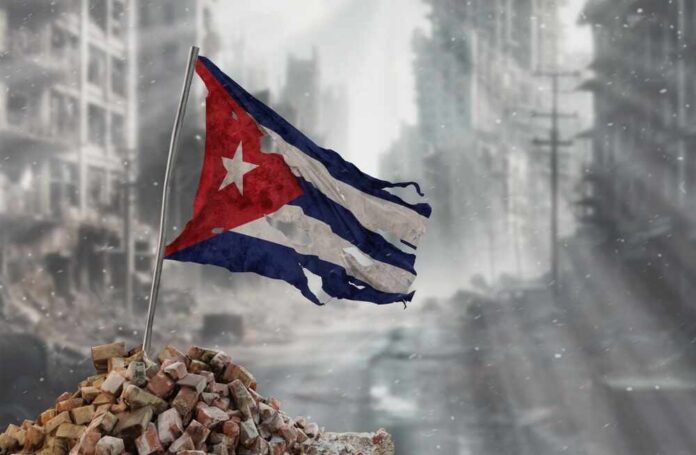
Trump’s “Cuba’s next” talk is colliding head-on with a conservative base already exhausted by costly foreign entanglements and wary of a new, open-ended front.
Story Snapshot
- President Trump referenced Cuba as potentially “next” during a speech at his Doral resort while promoting a new regional security effort called “The Shield of the Americas.”
- The White House has already escalated pressure with a national emergency declaration targeting threats tied to the Cuban government, including foreign intelligence and security alignments.
- Cuba publicly pushed back, declaring it is “free, independent and sovereign,” signaling it will not cooperate with U.S. demands.
- Conservatives who supported strong borders and national defense are increasingly split between confronting hostile regimes and rejecting another cycle of regime-change style conflict.
Doral speech fuels fresh questions about “what comes next”
President Trump’s remarks at his Doral resort in Florida—framing Cuba as potentially “next” after U.S. actions and confrontations in other hotspots—landed in a political climate already shaped by war pressures abroad. The comment was reported as off-the-cuff and delivered with a wink of plausible deniability, even as he highlighted a hemispheric security initiative dubbed “The Shield of the Americas” alongside Latin American leaders.
The immediate issue for voters is not the headline-friendly phrasing, but the policy trajectory it hints at. The report describing the speech places the remark in a broader second-term pattern of hard power signaling. Because the speech date is described only as “Saturday” and not pinned to a precise calendar day, the timeline remains somewhat imprecise, but the direction of travel—more pressure and possible escalation—is clear.
National emergency order puts economic leverage at the center
The administration’s formal move is a national emergency declaration aimed at “addressing threats to the United States” posed by the Cuban government. That action leans heavily on national security framing, including allegations about hostile intelligence activity and foreign partnerships. It also establishes a tariff mechanism connected to the provision of oil to Cuba, expanding the pressure beyond Havana and onto third-country suppliers and intermediaries tied to Cuba’s energy lifeline.
For conservatives who prioritize limited government and constitutional restraint, emergency authorities can raise legitimate “how far does this go” questions even when the target is an adversarial regime. The White House position is that the threat environment justifies extraordinary steps. What’s missing in the available record is any detailed, independently sourced accounting of effectiveness—how quickly tariffs shift behavior, how enforcement will be measured, and what end-state would satisfy U.S. objectives without drifting into mission creep.
Why Cuba is being framed as a security threat close to home
The national security case described by the administration centers on Cuba’s relationships with major U.S. adversaries and hostile non-state actors. The White House action points to intelligence and defense alignments involving Russia and China, and also references connections with Iran as well as groups such as Hamas and Hezbollah. The research summary further highlights claims about a significant Russian signals intelligence presence and deepening Cuba-China cooperation.
Those allegations, if accurate, matter because they describe threats positioned within the Western Hemisphere rather than across an ocean. At the same time, the sources provided do not include third-party expert validation or declassified evidence beyond the government’s characterization. Conservatives who demand strong national defense can still reasonably ask for clearer thresholds: what specific activity triggers escalation, what constitutes deterrence success, and what concrete off-ramp prevents an incremental slide from sanctions to strikes.
MAGA tension: defend the homeland, but reject another endless war
Conservative voters are processing these developments through the reality of 2026: high energy costs, continued frustration with years of inflation and fiscal strain, and growing fatigue with prolonged military engagements—now including the ongoing war with Iran. That environment explains why even pro-Trump circles can split when rhetoric shifts from “peace through strength” toward another potential theater. The “Cuba’s next” line functions as a stress test for that divide.
Trump: “Cuba’s Next By the Way But Pretend I Didn’t Say That Please… Cuba’s Next.”
READ: https://t.co/H9uY7ZgDIi pic.twitter.com/D4YTeBcR7Z
— The Gateway Pundit (@gatewaypundit) March 28, 2026
Cuba’s public response has been defiant, with a Cuban official posting that the country is sovereign and “no one tells us what to do.” That posture makes de-escalation harder, but it also clarifies the stakes: deterrence messaging is being received and rejected, at least publicly. With limited reporting detail on internal Cuban deliberations or any back-channel diplomacy, readers should treat predictions of imminent conflict cautiously and focus on what is verifiable—emergency authorities, economic coercion, and sharpened public rhetoric.
Sources:
Addressing Threats to the United States by the Government of Cuba
Trump Cuba warning Iran Venezuela