Keffiyeh Ban Ignites Buchenwald Showdown
A single scarf has turned one of Europe’s most solemn memorials into a live-fire test of whether remembrance can survive modern political theater.
Story Snapshot
- A far-left anti-Zionist coalition is planning an April 11-12, 2026 protest timed to Buchenwald’s liberation anniversary commemorations.
- Buchenwald’s memorial foundation formalized rules in April 2025 that bar entry for visitors displaying certain pro-Palestinian symbols, including keffiyehs, Palestinian flags, and olive branch imagery.
- Organizers argue the restrictions amount to suppression and “revisionism,” while officials warn the demonstration risks flipping victim and perpetrator narratives.
- The protest is expected to take place outside the memorial grounds because the ban applies at the site itself.
Buchenwald’s rules were designed to keep politics out, then politics arrived anyway
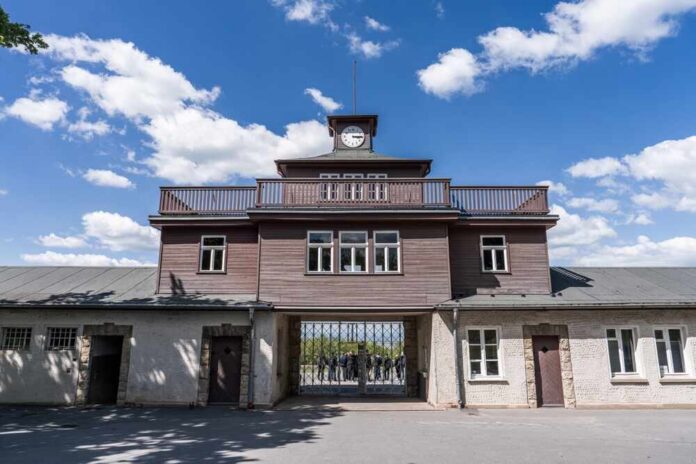
Buchenwald was liberated on April 11, 1945, and the annual commemoration is built around a simple expectation: you come to learn, mourn, and leave changed, not to campaign. That expectation now sits at the center of a dispute over symbols. After a legal fight tied to a visitor who wanted to enter wearing a keffiyeh as a political statement, the memorial foundation tightened and formalized restrictions in April 2025 that bar specific pro-Palestinian imagery.
The planned protest, scheduled for April 11-12, 2026, calls itself “Kufiyas in Buchenwald” and frames the ban as ideological enforcement rather than neutral site management. Organizers also point to the earlier controversy around Jewish philosopher Omri Böhm, who was disinvited from the 80th anniversary events after reported pressure linked to his public criticism of Zionism and the war in Gaza. Each side sees a bright line: one about keeping a memorial from becoming a billboard, the other about refusing a speech-policed version of history.
The activists’ strategy: use the calendar, use the location, and force a choice
The organizers chose the liberation anniversary on purpose because anniversaries compress attention. They also remove wiggle room for institutions: either the memorial tolerates a protest adjacent to its most sacred date, or it becomes the story for trying to prevent it. Plans described in coverage include guided tours, lectures, and panel discussions—formats that sound academic while still delivering a clear message. The protest’s branding signals confrontation, because it deliberately fuses a Palestinian symbol with a Nazi camp’s name.
That fusion is the accelerant. A keffiyeh is not a weapon, but symbols work by association, and association depends on context. The memorial’s leadership has expressed concern about attempts to “inappropriately exploit the commemoration.” That is institutional language for a real fear: people will leave arguing about today’s slogans instead of yesterday’s victims. If you run a memorial, you don’t just manage grounds; you manage meaning, and meaning can be hijacked in a single viral photo.
German officials hear “role reversal,” and they’re not wrong to be wary
Germany’s antisemitism commissioner, Felix Klein, condemned the planned demonstration as “a new low” and warned about a “reversal of roles between victim and perpetrator.” That phrase matters because it speaks to a pattern seen across Western activism: collapsing distinct historical events into a single moral script where the same villains and victims appear in every era. Conservatives should recognize the hazard immediately. When politics becomes a template, nuance dies, and the loudest faction gets to label everyone else as complicit.
At the same time, governments and cultural institutions can overreach when they try to solve a political problem with bans and gatekeeping. Blanket symbol prohibitions risk transforming a memorial into a checkpoint for acceptable opinions, which invites legal challenges and builds martyr narratives for activists. American common sense says you can defend a solemn space without pretending you can control what every visitor thinks. The harder question is what rules actually preserve dignity, and which rules simply hand agitators a bigger megaphone.
The unresolved tension: a memorial is not a town square, but it can’t be a party headquarters either
The Buchenwald foundation appears to allow some national symbols while restricting others, and critics cite that imbalance as proof of politics disguised as neutrality. Supporters of the restrictions counter that certain symbols have become flashpoints in Europe, and that the site must prevent harassment, intimidation, or clashes during commemorations. Limited public detail exists about the full legal reasoning behind the court decision, which leaves outsiders arguing from headlines rather than a shared record of facts.
Here’s what can be said cleanly: Holocaust memorials operate differently from streets and parks because their purpose is educational remembrance, not public assembly. A dress code in a courtroom does not equal censorship; it signals respect for the function of the room. But a memorial that drifts into one-sided enforcement risks becoming the very thing it claims to resist: an institution that uses moral authority to police today’s politics. That credibility, once lost, is hard to rebuild.
What to watch on April 11-12: optics, enforcement, and whether anyone learns anything
The protest is reportedly set for outside the memorial grounds, which sounds like a compromise until you remember how modern media works. Cameras do not care about property lines. If police intervene, that becomes the image. If they don’t, and the gathering grows, that becomes the image. If survivors and families feel disrupted, that becomes the image. Each scenario feeds a different narrative machine, and none of them naturally steer the public back toward the victims Buchenwald exists to remember.
This would be wildly distasteful if it happened. But also, the obvious place where this movement is headed on current trajectory. https://t.co/G0MKokcbVu
— Nick Tyrone (@NicholasTyrone) February 21, 2026
The best outcome looks boring: clear rules applied consistently, no grandstanding on sacred ground, and a commemoration that remains centered on history rather than hashtags. The likely outcome looks noisier. This dispute won’t stay confined to one German memorial; it sets a precedent for how Western institutions handle imported conflicts, activist symbolism, and the temptation to treat remembrance as a stage. The scarf is the prop. The real fight is over who owns the story.
Sources:
‘Keffiyehs in Buchenwald’? Protest Planned at Nazi Concentration Camp on Liberation Day
Antizionist group plans protest over Buchenwald memorial’s ban on keffiyahs
Far-left protest planned at Buchenwald memorial sparks outrage
Far-left protest planned against Buchenwald Memorial on liberation day
Pro-Palestinians plan protest at Nazi concentration camp on liberation day