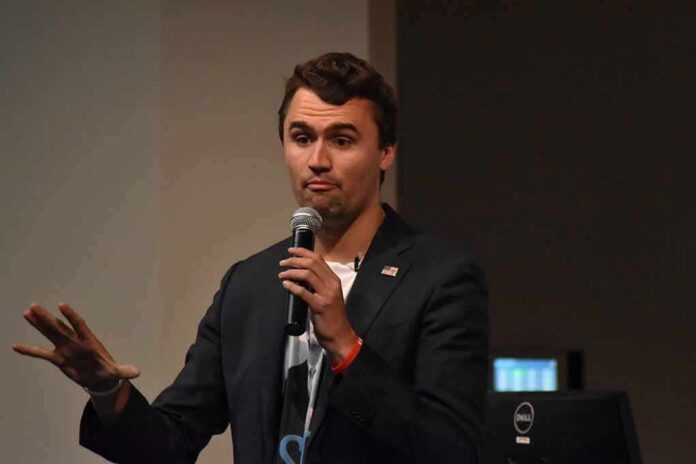
Charlie Kirk’s family says campus police were warned about rooftop access before the event—and the warning went unheeded, now central to a looming lawsuit.
Story Highlights
- The family filed a notice of claim alleging Utah Valley University ignored a rooftop-risk warning.
- Texts cited in reports show Kirk’s team flagged student roof access near the stage area.
- Utah Valley University says it will address the claim through standard processes and cited no credible threats before the event.
- Records tied to security planning remain heavily redacted, fueling questions about oversight.
Family’s Claim: Specific Rooftop Warning Was Sent Before the Shooting
ABC News reported that the notice of claim says Turning Point USA warned Utah Valley University’s campus police chief days before the event about student access to a nearby roof by the Sorensen Student Center. The Washington Post likewise reported the organization asked police to help secure rooftops before the speech. The claim argues the university still approved an outdoor venue with elevated vantage points. The family says this preventable gap helped enable the sniper attack that killed the conservative leader.
The notice of claim preserves the family’s right to sue Utah Valley University, the State of Utah, and specific officials for wrongful death and negligence, according to local reporting. The filing frames the case around foreseeability and duty. It says a clear warning came in, a known hazard existed, and action fell short. That chain is what courts often test in campus security cases: Was the risk flagged, who controlled the hazard, and did officials take on a duty to protect?
University Response: No Credible Threat, Open Campus, Outside Review
Utah Valley University said it is aware of the claim and will handle it through established legal processes. A spokesperson told a national outlet that campus police discussed security with Kirk’s team and assessed there were no credible threats before the event. Officials described the setting as an open-campus courtyard, which did not use metal detectors. The university also said it sought an outside review after the killing, though findings have not been released.
Reports at the time stated the fatal shot came from the top of the Losee Center, a campus building roughly 200 to 300 yards from the amphitheater where Kirk spoke. That elevated distance matches the family’s core claim: rooftops posed a known risk at an open-air event. Whether officials took steps to lock down access, post overwatch, or coordinate with city resources will likely be a key factual fight if the case advances in court.
The Legal Hinge: Foreseeability, Control, and Undertaking a Duty
Campus liability often turns on three questions: Was the harm foreseeable, did the institution control the hazard, and did it undertake a duty by promising or providing security? Legal scholarship and cases show colleges are not automatic insurers of safety, but may face liability if they assume control or receive specific warnings tied to a preventable risk. The family says a rooftop warning created a duty to secure or deny access. The university’s answer stresses no credible threat and an open campus.
Charlie Kirk’s security team flagged rooftop access before he even took the stage… and the police chief responded, “I got you covered.”
Now his family alleges that warning went unaddressed.
Erika Kirk and the family have filed a notice of claim against Utah Valley University,… pic.twitter.com/scvpExXvS2
— Fox News (@FoxNews) September 16, 2026
Transparency battles could shape public trust. Utah outlets reported Utah Valley University withheld or heavily redacted security planning and audit records, citing state law on protected security information. Those redactions may be lawful, but they leave citizens and grieving families with fewer answers. For many readers, that feels like the same old story: big institutions protect themselves first, while accountability waits on court deadlines and closed-door reviews.
Why This Matters to Readers Who Value Security and Accountability
Conservatives expect equal protection and basic competence. Kirk’s team asked for help watching the high ground, according to multiple reports. Families at public events should not need to beg for common-sense steps like securing rooftops. If a warning reached the right people, action should have followed. If it did not, the process failed. Either way, the public deserves a clear record of what was done, when, and by whom—without months of blacked-out pages.
Sources:
facebook.com, abcnews.com, archive.org, fox13now.com, judicialwatch.org, kutv.com, facilities.utah.edu, ktxs.com, dps.utah.gov, ue.org, detroitnews.com