
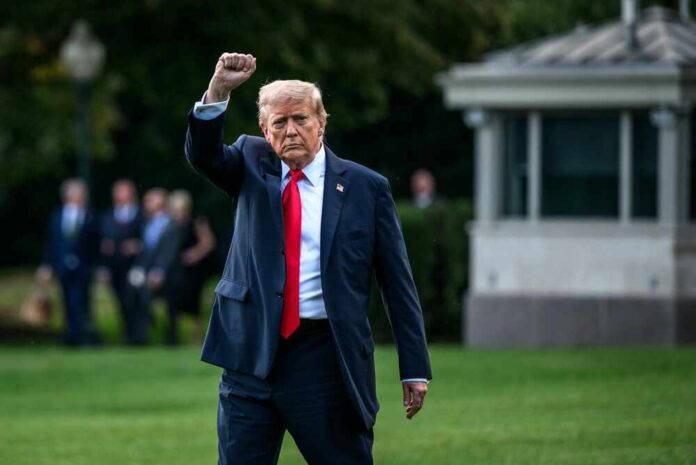
Trump’s so-called “revenge tour” is winning primaries and reshaping the Republican Party — but critics warn the political costs are beginning to pile up.
Story Snapshot
- Trump-backed challengers have defeated Republican incumbents in high-profile primaries in Louisiana, Kentucky, and Indiana in 2026, demonstrating the real power of party discipline.
- Critics label the primary campaigns a “revenge tour,” while Trump supporters frame the effort as consolidating a MAGA policy coalition and enforcing party loyalty.
- Axios reports the broader campaign of political pressure is creating friction on Capitol Hill, complicating Trump’s legislative agenda.
- Left-leaning groups are tracking Department of Justice investigations and prosecutions they claim follow Trump’s public denunciations of political opponents.
Revenge Tour or Party Discipline?
Trump’s 2026 primary intervention strategy has produced concrete results. Brookings reports that in mid-May, Trump-backed candidates won two high-profile primaries in Louisiana and Kentucky, following a pattern where Trump would recruit a challenger, fund the candidate, campaign alongside them, and defeat the sitting incumbent. Five Trump-backed challengers also defeated Republican incumbents in Indiana, according to CNN reporting. Supporters argue this is straightforward party discipline — enforcing MAGA priorities on lawmakers who broke ranks.
The primary targets were not random. Senator Bill Cassidy of Louisiana, who voted to convict Trump during his second impeachment, lost his re-election bid after Trump endorsed a rival and campaigned against him relentlessly. Axios described the broader effort as a “campaign of political vengeance,” though the same outlet acknowledged the strategy has been effective at reshaping the party. Whether this is revenge or political consolidation depends largely on which lens you apply — and Trump’s opponents have every incentive to choose the most damaging framing.
Left-Leaning Groups Claim Federal Agencies Are Being Weaponized
The liberal advocacy group Protect Democracy is operating a tracker that catalogs Department of Justice (DOJ) investigations and prosecutions it characterizes as retaliatory, claiming many were preceded by direct public threats from Trump. A Wikipedia-style summary of the second Trump administration’s actions names more than a dozen federal agencies — including the DOJ, Department of Homeland Security, Internal Revenue Service, and Federal Communications Commission — as allegedly used to target political opponents. These claims come from sources with clear anti-Trump agendas and rely heavily on inferred motive rather than documented directives.
The critical evidentiary problem for these accusations is that none of the available sources produce internal White House memos, sworn testimony, or agency directives that conclusively prove retaliation was the primary motive behind specific actions. Timing and public rhetoric are used to infer intent — a standard that could characterize almost any aggressive executive action as politically motivated. Ordinary enforcement decisions, personnel changes, and coalition-building efforts can all be reframed as revenge when the target happens to be a political opponent.
Political Costs Are Real, But So Is the Strategic Logic
Axios reported in May 2026 that Trump’s revenge politics is “coming back to haunt him,” citing friction with congressional Republicans whose cooperation he needs to pass legislation. The argument is that defeating incumbents in primaries creates a chilling effect in Congress, making lawmakers more cautious about publicly supporting Trump’s agenda for fear of being seen as insufficiently loyal — a dynamic that can slow deal-making. That tension is real and worth watching as the legislative calendar fills up.
From a conservative standpoint, the strategic logic behind Trump’s primary campaigns is straightforward: a Republican Party that reliably votes with its president is more effective than one fractured by dissenters who undermine the agenda from within. The left and establishment media will always label aggressive party discipline as “revenge” because it serves their narrative. What Trump’s record actually shows in 2026 is a president using the tools available to him — endorsements, campaign resources, and public pressure — to build a governing coalition. Whether those tools are being used wisely is a legitimate debate; whether they constitute an abuse of power requires far more evidence than critics have produced.
Sources:
[1] Web – TINA BROWN: DIRE WARNING TO DEMS!
[2] Web – Trump’s revenge politics comes back to haunt him – Axios
[3] Web – So far, Trump’s political revenge campaigns have been successful
[4] Web – Targeting of political opponents and civil society under the second …
[5] YouTube – Trump’s revenge and retribution against his opponents
[6] Web – Tracking retaliatory use of arrests, prosecutions, and investigations …
[7] Web – Trump’s Politics of Revenge: Retribution, Power, and the Road to …