Scientists now believe Saturn’s iconic rings may have been born from a catastrophic moon collision that also resurfaced Titan, challenging decades of astronomical assumptions and demonstrating how even our solar system’s most stable features can be products of violent cosmic upheaval.
Story Highlights
- New research reveals Saturn’s rings likely formed from violent moon collisions triggered by a lost moon merging with Titan approximately 500 million years ago
- NASA’s Cassini mission data exposed puzzles about Saturn’s unusually young rings and Titan’s smooth surface that previous theories couldn’t explain
- Scientists propose a chain reaction where the merger destabilized inner moons through gravitational resonances, creating ring debris
- NASA’s Dragonfly mission arriving at Titan in 2034 will test the hypothesis by searching for collision signatures on the moon’s surface
Cassini Mission Reveals Saturn’s Hidden Mysteries
NASA’s Cassini spacecraft mission from 2004 to 2017 uncovered perplexing anomalies in Saturn’s system that defied conventional planetary science. The probe’s measurements revealed Saturn’s rings are only approximately 100 million years old, extraordinarily young compared to the planet’s 4.5-billion-year age. Additionally, Cassini discovered Saturn’s mass distribution had shifted, disrupting the planet’s expected precession resonance with Neptune. These discoveries demanded explanations that previous astronomical models could not provide, prompting researchers at the SETI Institute, MIT, and UC Berkeley to develop new theories about the Saturn system’s violent past.
The Lost Moon Theory Emerges
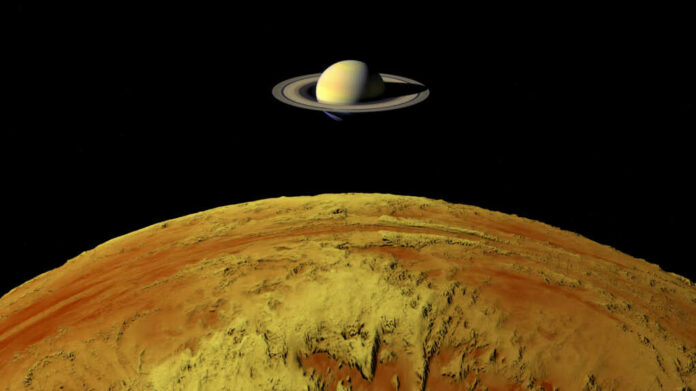
Researchers developed the “Chrysalis” hypothesis proposing that a lost moon roughly the size of Iapetus once orbited Saturn before being destabilized by Titan’s outward migration. The SETI Institute’s Matija Ćuk refined this theory through computer simulations, demonstrating that this lost moon likely merged with a proto-Titan rather than being torn apart directly by Saturn. This merger would have resurfaced Titan, erasing ancient impact craters and producing fragments that became Hyperion, Saturn’s irregularly shaped moon. The collision released enormous energy, fundamentally transforming Titan from a cratered, Callisto-like body into the geologically young moon we observe today with NASA’s telescopes.
Gravitational Chain Reaction Created the Rings
Following the merger with proto-Titan approximately 500 million years ago, the newly enlarged Titan’s modified orbit triggered gravitational resonances throughout Saturn’s moon system. These resonances destabilized inner moons over the subsequent 100 to 200 million years, eventually causing catastrophic collisions among them. Computer simulations predict that approximately five to ten percent of the debris from these inner moon collisions persisted as the spectacular ring system we observe today, while Saturn’s gravity consumed the remaining material. This chain-reaction model elegantly connects multiple puzzles including Titan’s eccentric orbit, Hyperion’s recent orbital lock with Titan, and the rings’ surprisingly young age.
Evidence Points to Hyperion as Smoking Gun
Hyperion’s existence provides the most compelling evidence supporting the merger hypothesis, according to lead researcher Matija Ćuk. The irregularly shaped moon tumbles chaotically in its orbit and only recently became gravitationally locked to Titan within the last few hundred million years. Ćuk stated that if the extra moon merged with Titan, fragments would likely form near Titan’s orbit, precisely where Hyperion exists today. Unlike Saturn’s other regular moons, Hyperion’s peculiar characteristics match predictions for collision debris rather than a moon formed through normal accretion processes. This connection between Titan’s violent past and Hyperion’s unusual properties strengthens the case for the catastrophic merger scenario over competing theories.
A lost moon may have created Titan and Saturn’s rings
Saturn’s largest moon, Titan, may have been born in a colossal cosmic crash. New research suggests Titan formed when two older moons slammed together hundreds of millions of years ago—an event so violent it reshaped Saturn’s…
— The Something Guy 🇿🇦 (@thesomethingguy) February 27, 2026
NASA’s upcoming Dragonfly mission, scheduled to arrive at Titan in 2034, will test this hypothesis by searching for geological evidence of the ancient collision. The spacecraft will examine Titan’s surface composition and structure for signatures consistent with a massive impact approximately 500 million years ago. This represents a prudent use of taxpayer-funded space exploration to verify scientific theories through direct observation rather than speculation. The mission’s $850 million investment advances American leadership in planetary science while potentially rewriting textbooks about moon formation throughout giant planet systems, demonstrating how catastrophic events shape celestial bodies over cosmic timescales in ways previously unimagined.
Sources:
A lost moon may have created Titan and Saturn’s rings – ScienceDaily
A lost moon may have created Titan and Saturn’s rings – Phys.org
Chrysalis: The lost moon that gave Saturn its rings – UC Berkeley Research
A Missing Moon May Have Created Both Titan and Saturn’s Rings – SciTechDaily