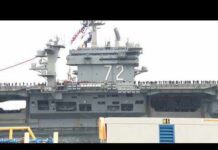
After more than 250 days at sea, the USS Abraham Lincoln is finally headed home as a relief carrier moves in to take its place.
Story Highlights
- The Navy is rotating the USS Abraham Lincoln home after an unusually long deployment.
- The USS George Washington is deploying to relieve the Lincoln in the Middle East.
- Past Navy statements confirm the Lincoln’s recent combat deployments and homecomings to San Diego.
- Extended carrier tours reflect wider strain on the fleet beyond the seven-month goal.
Carrier Relief Signals Long-Awaited Homecoming
U.S. officials said the aircraft carrier USS George Washington is heading to the Middle East to replace the USS Abraham Lincoln, clearing the way for the Lincoln to return to its homeport after a protracted tour. The move marks the latest rotation in a demanding cycle that has kept American carriers on station for far longer than planned. Navy leaders have framed the change as part of a scheduled deployment plan to maintain pressure and deterrence in a tense region.
The Lincoln serves as the flagship of Carrier Strike Group 3. The ship previously returned to San Diego on December 20, 2024, after a five-month deployment that included combat operations across multiple fleet areas, according to an official Navy release. Stars and Stripes also reported that homecoming, highlighting the Lincoln’s role and tempo in operations tied to the Middle East and the Pacific. Those records show a pattern of heavy tasking for the carrier and its air wing.
Extended Deployments Are Now Common
Stars and Stripes reported that the Lincoln’s current stretch has surpassed the Navy’s notional seven-month target, joining a run of carriers forced to stay out longer due to global demand and relief timing issues. That mismatch drives stress on crews, ships, and families. It also reflects how the Navy must meet real-world threats despite tight maintenance windows and a finite number of ready flattops. Commanders use relief swaps like this to hold the line without leaving gaps.
In recent years, the Lincoln has seen both routine and record-setting cruises. The carrier has previously logged one of the longest modern deployments, and official accounts point to repeated high-tempo operations spanning the Third, Fifth, and Seventh Fleet areas. Those facts track with a broader fleet reality: when a relief is delayed, the on-station carrier stays. The result is longer tours that strain equipment and people but keep American airpower on call where it counts.
What This Means For Readiness And Families
The relief by the George Washington keeps U.S. strike aviation forward while giving the Lincoln’s crew a long-needed reset. Sailors and families have shouldered the burden of extensions and compressed timelines. A clean handoff helps preserve combat readiness and morale. It also supports needed maintenance so the ship and air wing return to peak condition. That is how the fleet stays lethal without burning out the force that makes it lethal in the first place.
🛑GLOBAL NEWS
The U.S. Navy says there was “no loss of life” aboard the USS Abraham Lincoln as CENTCOM Commander Admiral Brad Cooper visited the carrier ahead of its return home.
The visit capped Cooper’s 10-day regional tour, which included Bahrain, Iraq, Israel, Jordan, Saudi… pic.twitter.com/9oy1lnhFiM
— UKWELITIMES WORLD (@UKWELINEWSWORLD) August 16, 2026
For conservative readers, this is a reminder of first principles. Peace comes from strength, not slogans. The Lincoln’s rotation home after a hard tour shows the United States will meet threats without blinking, while still caring for the men and women who carry the load. The Navy’s own records of the Lincoln’s prior combat deployments and homecomings back up that story, even as today’s extended timelines prove how tight the margin remains.
Sources:
newsnationnow.com, stripes.com