A federal move to unseal “Fang Fang”-era FBI files is colliding with a hot California governor’s race—raising fresh questions about whether Washington’s vast investigative powers are being used for truth, politics, or both.
Quick Take
- FBI Director Kash Patel has ordered agents to redact and prepare decade-old files tied to Rep. Eric Swalwell’s past contact with Christine Fang, a suspected Chinese intelligence operative.
- Swalwell, now running for California governor, says the push is Trump-driven “election interference,” while Democrats warn of FBI “weaponization.”
- Public reporting says the FBI briefed Swalwell in 2015 about Fang’s suspected ties; Swalwell cut off contact and Fang later left the U.S. for China.
- A House Ethics Committee probe closed in 2023 with no finding of wrongdoing by Swalwell, even as it warned members broadly about foreign influence risks.
What Patel Ordered—and Why the Timing Matters
Late March reporting says FBI Director Kash Patel directed San Francisco-based agents to redact and prepare files from a closed counterintelligence investigation involving Rep. Eric Swalwell and Christine Fang, also known as “Fang Fang.” The unusual element is timing: the case never produced charges, yet the files are being prepared for release while Swalwell campaigns for California governor ahead of a June primary. The FBI has not publicly explained intent or a release schedule.
Patel’s order has immediate political consequences even without new allegations. California’s governor’s race already sits under national scrutiny during Trump’s second term, with foreign policy dominating headlines and domestic trust in institutions still frayed. Releasing sensitive counterintelligence material—especially material tied to an uncharged matter—can shape public perception before voters see any verified, complete context. That reality is why both process and proof matter as much as the headlines.
The Underlying “Fang Fang” Timeline, Based on Public Reporting
Public accounts trace the contact back to 2012, when Fang connected with Swalwell’s early congressional campaign. Reporting says Fang later helped with fundraising and placed an intern in Swalwell’s Washington office by 2014. In 2015, the FBI briefed Swalwell and other officials about Fang’s suspected ties to China’s Ministry of State Security, and Swalwell reportedly cut off contact. Fang subsequently left the United States and returned to China.
The case reentered public view after media reports in 2021 laid out the basic contours of the FBI’s concerns—namely, that China’s intelligence services sought to cultivate relationships with local and rising politicians in the Bay Area. Even then, the core fact remained: the government did not charge Swalwell. That distinction matters for constitutional-minded readers because reputations can be destroyed through insinuation, while accountability requires concrete, provable conduct.
Swalwell’s Defense and the “Weaponization” Accusation
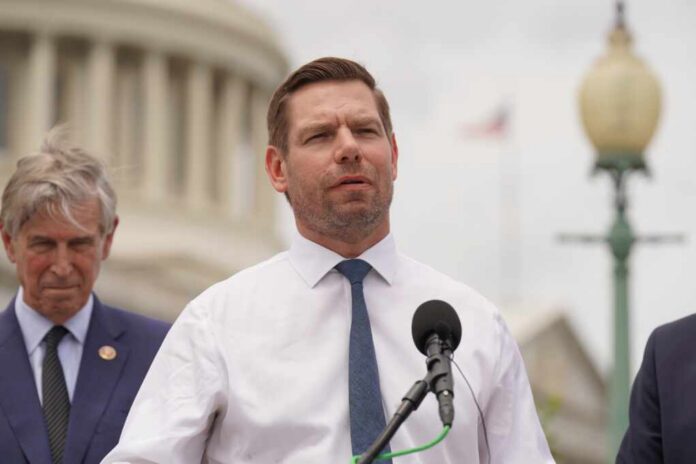
Swalwell has responded by framing Patel’s directive as politically motivated, saying President Trump is targeting him to influence the California election. Democratic allies have echoed that theme. Rep. Jamie Raskin has characterized the effort as “weaponization” and alleged it could implicate Hatch Act concerns. Other Democrats argue the FBI is spending time reopening a matter that ended without wrongdoing. Those claims, however, still hinge on motives not proven by the released materials—because the materials are not public yet.
Conservatives who watched federal power expand for decades should separate two questions. First, did a hostile foreign actor attempt influence operations around American politicians? Public reporting indicates yes, broadly, and the U.S. should treat that threat as real. Second, should the FBI publish files from uncharged investigations during an active election? That practice can collide with due process norms if disclosures become selective, incomplete, or timed to damage rather than inform.
Ethics Committee Closure Limits What Can Be Claimed
A key constraint on the current political narrative is the 2023 House Ethics Committee outcome. Reporting says the committee closed its multi-year review and found no wrongdoing by Swalwell, while still warning lawmakers generally about foreign gifts and influence risks. That closure does not prove the underlying intelligence concerns were imaginary; it does mean investigators did not establish an ethics violation by Swalwell. Any new public release should be measured against that documented endpoint.
Transparency vs. Trust at a Moment of National Strain
America is navigating a volatile moment—high costs, skepticism toward “forever wars,” and a base that is increasingly wary of institutions that feel unaccountable. That context makes transparency appealing, especially when foreign espionage is involved. But transparency that looks partisan can backfire by deepening public distrust in federal law enforcement. If Patel’s release is thorough, properly redacted, and tied to a clear public-interest rationale, it may strengthen oversight; if not, it may weaken credibility.
(VIDEO) Eric Swalwell Responds to Kash Patel’s Push to Release Fang Fang Files, Cries Election Interference
READ: https://t.co/0AhPmpM4Op pic.twitter.com/db87UBMrAT
— The Gateway Pundit (@gatewaypundit) March 30, 2026
For voters, the immediate practical question is straightforward: will the file release contain materially new, verifiable facts, or will it recycle already-known details without establishing misconduct? Until the documents are public, claims of “smear” or “vindication” are premature. For constitutional conservatives, the lasting issue is bigger than Swalwell: whether federal investigative files can be surfaced in election season without a consistent standard that protects civil liberties, due process, and equal treatment under law.
Sources:
FBI Director Reportedly Pushes to Release Files on Probe of Eric Swalwell
FBI Director Reportedly Pushes to Release Files on Probe of Eric Swalwell
Patel pushes old files on Swalwell’s alleged Chinese spy ties