
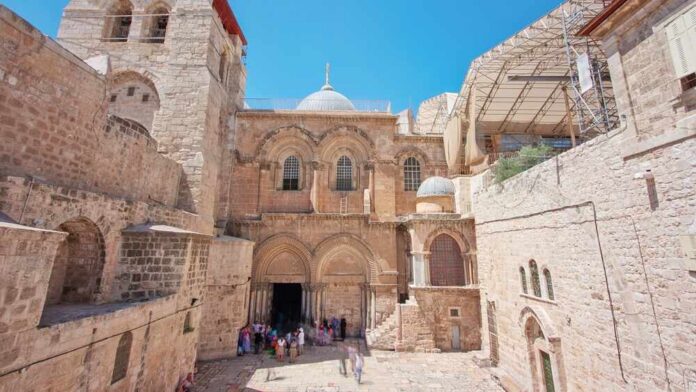
Archaeologists uncover ancient garden traces beneath Jerusalem’s Church of the Holy Sepulchre, offering tangible evidence that bolsters biblical accounts of Jesus’ burial and challenges modern skepticism about Christian foundations.
Story Highlights
- Excavations since 2022 reveal 2,000-year-old olive trees and grapevines, matching Gospel of John’s description of a garden near Jesus’ tomb.
- Findings reinforce the church’s traditional sites of crucifixion and resurrection without discovering a new tomb.
- Lead archaeologist Francesca Romana Stasolla confirms the site’s evolution from quarry to garden-burials, deepening historical understanding.
- Religious communities approved digs during restorations, balancing faith preservation with scholarly inquiry.
Excavation Discoveries Align with Scripture
Archaeologists from Sapienza University of Rome, led by Francesca Romana Stasolla, began excavating beneath the Church of the Holy Sepulchre floor in 2022 during restoration work. They uncovered traces of 2,000-year-old olive trees and grapevines, indicating an ancient garden. This directly echoes John 19:40-42, where Jesus’ body was laid in a new tomb in a garden near Golgotha. The evidence dates to the first century, the era of Christ, providing archaeological corroboration for the Gospel narrative. No new tomb emerged, but the garden remnants strengthen the site’s biblical authenticity.
Historical Foundations of the Holy Site
Emperor Constantine built the church in the 4th century after his mother Helena identified the location under a Roman temple to Venus. The site originated as a first-century quarry repurposed for rock-hewn tombs. Constantine isolated the venerated tomb, constructing the church inaugurated around AD 335. It endured destructions, including by Fatimids in 1009, and multiple reconstructions. The Edicule shrine features the Chapel of the Angel and Tomb of Christ with a marble slab over a 4th-century limestone bed, as confirmed in 2016 restorations. Shared custodianship by Greek Orthodox, Armenians, and Catholics governs access.
Stasolla’s team revealed 4th-century circular monument foundations and additional quarry tombs under the Edicule. These layers illustrate the site’s transformation from industrial quarry to sacred garden-burial ground. Religious communities permitted the non-disruptive digs amid heavy pilgrimage traffic, prioritizing structural integrity and historical verification.
Expert Insights and Broader Significance
Stasolla stated the findings show how the quarry evolved into multi-level burials, with Constantine selecting and enclosing Jesus’ tomb. Reports emphasize that the garden evidence lends credence to the Gospel without definitively proving the exact tomb location, relying on longstanding tradition. Skeptics acknowledge the contextual match, while Christian scholars view it as validation amid rising secular doubts. The discoveries parallel debates over alternative sites like the Garden Tomb, favoring Holy Sepulchre traditions rooted in early church history.
Under the Church of the Holy Sepulcher, Archeologists Found What Could Be the Tomb of Jesushttps://t.co/xoBFPnLVMI
— PJ Media (@PJMedia_com) April 15, 2026
In 2026, as Americans across political lines grow wary of elite institutions drifting from founding principles, this find reminds us of enduring truths grounded in evidence and faith. It counters narratives eroding traditional values, affirming the Christian heritage that shaped Western liberty and individual responsibility. Pilgrimage surges, like after 2016, boost Jerusalem’s economy while bolstering believers facing cultural pressures. Biblical archaeology advances, offering common ground for those seeking authenticity beyond government failures.
Sources:
Garden Found Under Jerusalem’s Church of the Holy Sepulchre
Ancient Garden Discovered Under Church of the Holy Sepulchre in Jerusalem
Echoing Gospel account, traces of ancient garden found under Church of Holy Sepulchre
Archaeologists May Have Found the Site of Jesus’s Tomb