
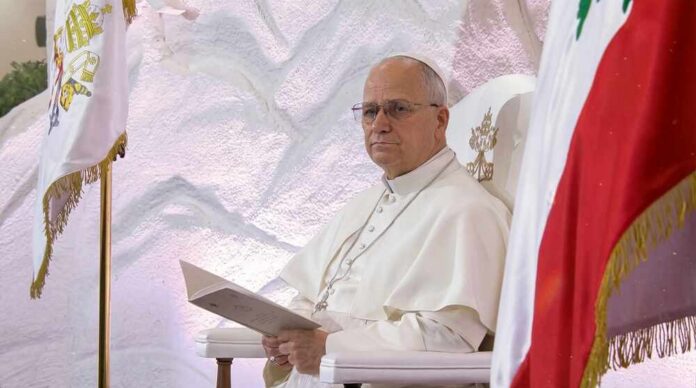
A new Vatican push to ‘disarm’ artificial intelligence weapons is landing just as America is finally rebuilding its military strength under President Trump.
Story Snapshot
- The Holy See is urging a global moratorium and possible ban on lethal autonomous weapons and other military uses of artificial intelligence.[1]
- Pope Leo XIV links artificial intelligence and advanced weapons to a dangerous erosion of human responsibility in war.[1]
- Vatican officials want stronger “supranational” institutions and new global rules on artificial intelligence and disarmament.
- The push raises serious questions for American sovereignty, deterrence, and the constitutional duty to provide for the common defense.
Vatican Pushes ‘Disarmed’ Artificial Intelligence on the World Stage
The Holy See has moved aggressively into the artificial intelligence debate, tying advanced technology to its longstanding campaign against modern weapons and nuclear deterrence. Catholic media report that Vatican diplomats at United Nations disarmament meetings called for a moratorium on artificial intelligence weapons development, especially so‑called lethal autonomous weapons systems that can select and engage targets without direct human input.[1] They frame these systems as a grave ethical concern because they lack uniquely human moral judgment about life and death decisions.
In a message for the World Day of Peace, Pope Leo XIV argued that military applications of artificial intelligence have “worsened the tragedy of armed conflict,” warning that political leaders are increasingly delegating decisions to machines rather than assuming personal responsibility.[1][3] His language builds on earlier papal teaching that condemned not just the use of nuclear weapons but even their possession as morally unacceptable, portraying weapons of mass destruction as offering only a “false sense of security.”[3] That moral framework now underpins a broader call to “disarm” both communication and technology.
From Nuclear Disarmament to ‘De‑Weaponizing’ Artificial Intelligence
The Vatican’s position did not appear overnight; it flows from decades of papal statements against arms races. Pope Francis previously labeled nuclear disarmament a “moral imperative,” rejecting arguments that simply possessing the bomb could be justified as deterrence.[3] Under Pope Leo, that logic is being extended into cyberspace, outer space, and artificial intelligence. A Vatican News summary of a Holy See intervention at a United Nations disarmament conference says the Church insists outer space and artificial intelligence “must not be weaponized,” and that nations must recommit to disarmament amid a massive expansion of arms.
Archbishop Gabriele Caccia, the Holy See’s representative at the United Nations, told the Disarmament Commission that governments should regulate artificial intelligence alongside nuclear weapons and abandon what he called the “fallacy of nuclear deterrence.”[2] He linked artificial intelligence governance to strengthening global institutions and international law, arguing that peace depends less on military capability and more on mutual trust through supranational frameworks.[3] That approach clearly favors international oversight and global rule‑making, in sharp contrast with America’s constitutional model that vests war and treaty powers in elected national leaders.
Encyclical ‘Magnifica Humanitas’ and the Call to ‘Disarm Communication’
The Vatican is giving this agenda even more weight through Pope Leo XIV’s first encyclical, Magnifica Humanitas, which multiple Catholic outlets say directly addresses artificial intelligence and world peace.[1][2] The head of the Pontifical Academy of Theology explained that the document will argue an ethical “code” for artificial intelligence is not enough; instead, humanity must embrace a Christian vision of the human person and creation to guide technology.[2] He called for a “great political and social revolution” that recognizes the earth as a gift and all people as children of God deserving protection.[2]
In parallel, Pope Leo has urged media and technology professionals to “disarm words,” reject a “war of words and images,” and treat communication as a tool for peace rather than conflict.[1] He warns that artificial intelligence’s immense potential demands “responsibility and discernment” so it benefits all humanity rather than deepening division or violence.[1] An upcoming Vatican observatory on artificial intelligence will engage business and economic leaders, seeking what officials describe as ethically oriented technological development that always safeguards human dignity.[2] Supporters say such formation can shape artificial intelligence systems through technical evaluations and Christian moral principles, rather than leaving them to raw market forces.[1]
What This Means for American Sovereignty, Deterrence, and Security
For conservative Americans, several red flags emerge in this push to “disarm” artificial intelligence. The Holy See is not merely urging prudence or transparency; it is aligning artificial intelligence controls with nuclear disarmament and pressing for a moratorium on entire classes of weapons.[1] At the same time, Vatican diplomats emphasize strengthening supranational institutions and international law as primary tools for peace.[3] That model risks empowering global bureaucracies that are unaccountable to the American voter, undermining the Constitution’s clear allocation of defense powers to our own elected branches.
Pope Leo warns that concentrated AI control lowers conflict thresholds and erodes accountability, calling for international regulation. Geopolitical rivalries remain the obstacle.
— War Intel (@war_intell) May 25, 2026
There is also a practical question: hostile regimes in Beijing, Moscow, and Tehran have shown little interest in binding themselves to stringent artificial intelligence or weapons limits. The evidence offered in the Catholic record is largely moral and theological, not technical, and does not provide concrete mechanisms for verifying or enforcing artificial intelligence disarmament across adversarial states.[1] Without credible verification and enforcement, sweeping bans could handicap the United States and its allies while leaving bad actors free to develop precisely the autonomous systems that threaten innocents and destabilize regions.
Balancing Moral Concerns with a Realistic Defense Posture
Thoughtful conservatives can recognize legitimate moral worries about outsourcing lethal decisions to code while still insisting that policy stay grounded in reality. The Vatican is right that human beings, not algorithms, must ultimately answer for life‑and‑death choices in war, and that technology should serve human dignity rather than erase it.[3] American policymakers can respect that warning without surrendering constitutional sovereignty or adopting blanket moratoria that ignore battlefield realities and asymmetric threats.
A serious conservative approach would keep meaningful human control at the center of weapons deployment, require tough oversight for artificial intelligence tools, and push for targeted international norms where verification is possible. It would also reject efforts to use disarmament rhetoric to justify broader attacks on national defense, border security, or the Second Amendment. As President Trump’s administration navigates this new Vatican campaign, the core principles remain the same: defend American lives, preserve constitutional self‑government, and ensure that new technologies strengthen, rather than weaken, the peace through strength that keeps our families safe.
Sources:
[1] Web – Holy See renews call for moratorium on AI weapons-development
[2] Web – Holy See warns global nuclear disarmament, AI regulation …
[3] Web – Nuclear disarmament now a ‘moral imperative’ as Pope Francis …