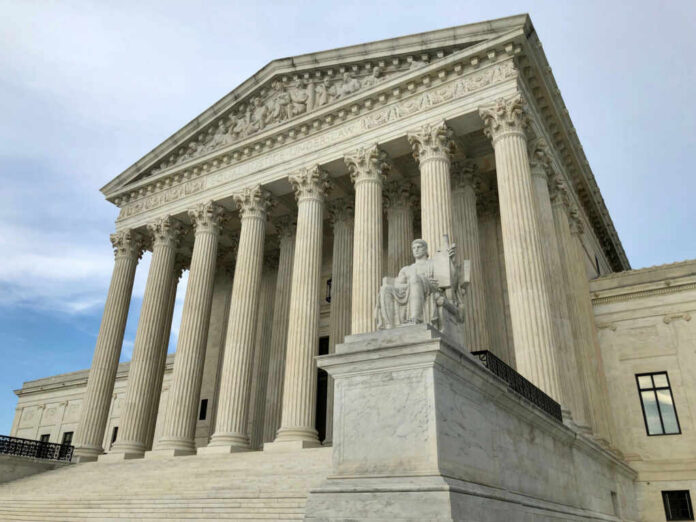
A Supreme Court fight over birthright citizenship now pits long‑standing constitutional text against a White House trying to stop “citizenship tourism” and illegal immigration from turning into automatic citizenship for millions.
Story Snapshot
- The Supreme Court is weighing President Trump’s Executive Order 14160, which limits birthright citizenship for children of illegal and temporary visitors.
- Liberal legal groups claim the order defies the Fourteenth Amendment and a 1898 Supreme Court case, while lower courts have put the order on hold.
- The administration argues the Constitution never promised automatic citizenship for children of parents whose true home and loyalty lie elsewhere.
- Families, taxpayers, and border communities across America are watching for a ruling that could reshape immigration and voting for generations.
What the Constitution Says and Why Wong Kim Ark Matters Now
The Fourteenth Amendment says that all persons born or naturalized in the United States, and subject to its jurisdiction, are citizens of the United States. In 1898, the Supreme Court decided United States v. Wong Kim Ark, holding that a man born in San Francisco to Chinese parents was a citizen because he was born on American soil and his parents were not foreign diplomats or invading troops.[5] That ruling has been treated as the main precedent for birthright citizenship ever since.[1]
For more than a century, both courts and federal agencies have read Wong Kim Ark to mean that most children born here are citizens, even when their parents are not.[2] The State Department and other agencies built their rules for passports and other documents on that understanding. At the same time, the Court did not squarely decide what happens when parents are in the country only briefly or in open violation of the law, which leaves a gray area that today’s Court is finally being asked to address.[5]
Trump’s Executive Order 14160 and the “Domicile” Debate
On his first day back in office in 2025, President Trump signed Executive Order 14160, “Protecting the Meaning and Value of American Citizenship.”[26] The order says that a child born in the United States is not automatically a citizen if the mother was here illegally or only on a temporary visa and the father was not a citizen or lawful permanent resident at the time of birth.[26] It directs federal agencies not to issue or honor citizenship documents for people in those categories.[26]
The order turns on the words “subject to the jurisdiction thereof.” Supporters argue that phrase has always meant full, direct allegiance to the United States, not just physical presence.[17] They say parents who are here only as tourists, students, or illegal border crossers remain legally tied to another country, so their children are not within the Amendment’s promise. In Supreme Court arguments this spring, the administration stressed that it is not asking to overrule Wong Kim Ark, but to correct what it calls a century of overreading that case.[11]
Lower Courts Push Back While the Supreme Court Hears the Case
Liberal advocacy groups, including the American Civil Liberties Union and the Asian Law Caucus, rushed to court within hours of the order. They claim the order “seeks to strip” babies of citizenship that the Constitution itself grants and warn that affected children could be denied Social Security cards, passports, medical coverage, and even the right to vote when they grow up. Several federal courts agreed and issued nationwide injunctions blocking the order from taking effect, calling it a clear violation of the plain language of the Fourteenth Amendment and over a century of Supreme Court precedent.
The lead Supreme Court case, Trump v. Barbara, is a nationwide class action on behalf of children who would be denied citizenship under the order.[24] In that case, lower courts said the order clashes with the Citizenship Clause, the Wong Kim Ark decision, and a long‑standing federal statute that defines who is a citizen at birth.[24] These courts have “uniformly blocked” the administration from enforcing the policy so far, which is why the Supreme Court’s coming ruling is so important.[24] A decision is expected by early summer, and it will either green‑light or shut down this new approach to citizenship for good.[7]
Families, Taxpayers, and the High Stakes for America’s Future
While activists on the left frame the case as an attack on immigrant families, many conservative Americans see something else: a long‑overdue defense of citizenship, the rule of law, and national sovereignty. For years, people have watched women fly in on tourist visas to give birth, or cross the southern border illegally, knowing that a baby born here is treated as an instant citizen with a path to welfare programs and future voting power. President Trump has called this “birthright citizenship” system a burden on taxpayers and a magnet for illegal immigration.[10]
And no I did give sources on the COVID lab.
And I told you I refuse to go searching for statements Trump made throughout his campaign trail and the past year and a half in regard to birthright citizenship and trying to get it before the Supreme Court. Especially right now when
— Fatsnowman123 (@fatsnowman123) June 18, 2026
The Supreme Court now faces a choice with huge consequences. If the justices strike down the order, they will lock in the broadest possible reading of birthright citizenship and leave it to a future Congress to act. If they uphold it, they will say that the Constitution does not force America to reward illegal entry or short‑term visits with automatic, permanent membership in the political community. Either way, families, border towns, and law‑abiding citizens will live with the fallout for decades.
Sources:
[1] YouTube – Families watch closely as Supreme Court weighs birthright citizenship
[2] Web – Birthright Citizenship Hub
[5] Web – United States v. Wong Kim Ark – Oyez
[7] Web – 8 FAM 102.3 SUPREME COURT DECISIONS – Foreign Affairs Manual
[10] Web – Analysis: How the modern Supreme Court might look at the 14th …
[11] Web – Supreme Court agrees to hear arguments in birthright citizenship …
[17] YouTube – SCOTUS vs Birthright Citizenship: Inside the arguments
[24] Web – Trump’s Birthright Citizenship Executive Order FAQ: Know Your Rights
[26] Web – Supreme Court Arguments Wrap in Landmark Challenge to Trump …