Serbia’s strongman president is stepping down just in time to reset elections and likely keep his grip on power from a different chair.
Story Snapshot
- Serbian President Aleksandar Vucic says he will resign within weeks, one year before his term ends.
- His move triggers early elections after long student-led anti-corruption protests and clashes with police.
- Vucic vows to lead his Serbian Progressive Party to a bigger win and may return as prime minister.
- The case shows how leaders in shaky democracies use “resignations” to stay in control, not to step aside.
Vucic’s surprise resignation and what it really does
Serbian President Aleksandar Vucic told thousands of supporters at a rally in Belgrade that he will be president for only a few more weeks and then resign his post.[5] His second and final term was due to end in mid-2027, so this decision cuts his official mandate short by about a year.[2] Vucic said the move will clear the way for early presidential and parliamentary elections, giving his ruling Serbian Progressive Party a fresh shot at power on a new timeline.[2]
At the same rally, Vucic promised that his party would win “more convincingly than ever before,” and pledged to help the right‑wing Serbian Progressive Party in the coming vote.[5] He has told party leaders he plans to “help us win the people’s trust for the next four years,” signaling that resignation does not mean political retirement.[8] Because Serbia’s prime minister holds more formal day‑to‑day power, analysts note this early exit could let Vucic return as prime minister if his party wins.[2]
Protests, corruption anger, and pressure from the streets
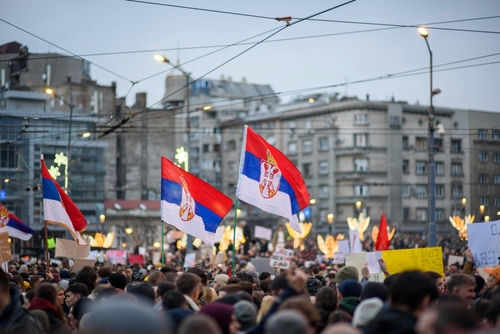
The announcement comes after about eighteen months of anti‑government protests, many led by university students outraged over corruption and negligence.[2] One key trigger was the deadly collapse of a railway station canopy in the northern city of Novi Sad in November 2024, which killed more than a dozen people and exposed deep anger at the government’s handling of public works.[2] Protesters have demanded free elections, accountability for officials, and Vucic’s resignation, facing tear gas and police charges during rallies.[8]
These protests did more than fill city squares; they also shook Serbia’s political class. In January 2025, Prime Minister Milos Vucevic resigned under pressure, along with the mayor of Novi Sad, in a partial victory for the movement.[11] The national parliament now has constitutional options: either form a new government within thirty days or call snap parliamentary elections.[17] Student leaders say that resignations at the top are not enough and insist on clean elections and real change, not cosmetic moves meant to calm the streets while the same network stays in charge.
Controlled elections and a playbook seen before
Serbia under Vucic is often described by researchers as a “competitive authoritarian” system, where elections happen but the playing field is tilted through media control and pressure on opponents.[22] Past snap elections, such as those in 2014, helped Vucic’s camp crush rival parties and deepen its hold over state institutions.[22] Freedom House’s recent report on Serbia highlights democratic backsliding and misuse of state tools, including pressure on minority communities and concerns over fair voter rolls.[20]
There is also a local pattern of leaders timing resignations to reset election calendars without truly giving up power. Former President Boris Tadic used an early resignation in 2012 to trigger elections on terms that favored his party.[18] Vucic’s current move fits that pattern: he has not set an exact resignation date, nor a firm election date, keeping tactical control over the schedule.[2] For Americans used to clear rules and fixed terms, this is a reminder of how fragile election systems can look once strong‑men start bending timelines to suit their own plans.
Why this matters for U.S. conservatives watching Europe
Vucic has been described as a populist ally of President Trump, and his rule shows both the promise and danger of strong leadership.[4] On one hand, he pushes back on European Union elites and globalist pressure, and many Serbs like his tough talk. On the other hand, critics point to growing media clampdowns, corruption, and police force against protesters as warning signs that sound a lot like the “deep state” behavior conservatives oppose at home.[4] His staged resignation is not about limited government; it is about rearranging chairs while the same circle keeps control.
For Trump‑supporting Americans, Serbia offers a cautionary picture. When one party dominates the media, tilts election rules, and uses police to manage dissent, regular elections alone do not guarantee liberty. Vucic’s promise to help his party win “more convincingly than ever” after protests and a deadly public safety failure shows how ruling elites can turn crisis into an excuse to tighten their grip.[5] Watching this unfold in Europe underscores why the U.S. Constitution, clean elections, and real checks on power must be guarded fiercely at home.
Sources:
[2] Web – Serbia’s populist President Vucic says he will resign within weeks as …
[4] Web – Serbian President Vucic says he will resign within weeks
[5] Web – Serbia’s prime minister resigns as anti-corruption protests sparked …
[8] Web – The resignation of Serbian Prime Minister Milos Vucevic is unlikely …
[11] Web – The Serbian Movement Against Violence – FPIF.org
[17] Web – Serbia’s President Vucic says he’ll resign within weeks, amid student …
[18] Web – Serbian prime minister resigns after weeks of anti-corruption protests
[20] Web – Serbian president says he will resign within weeks – Facebook
[22] Web – Serbia’s President Aleksandar Vucic says will resign within ‘weeks’