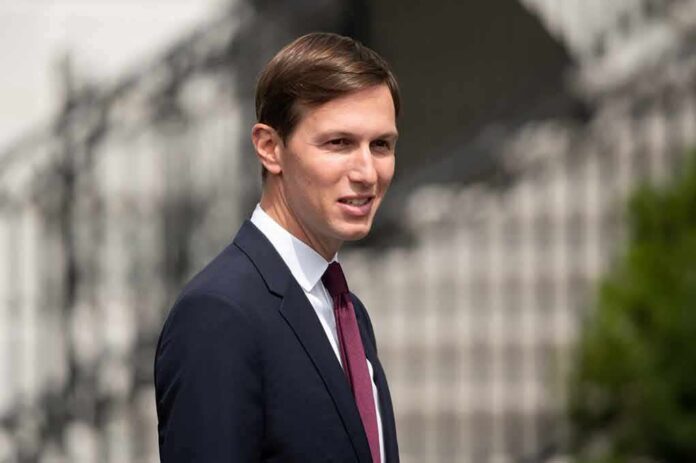
Jared Kushner forcefully denied a new book’s detailed claim that he had access to a Gulf-funded account moving hundreds of millions of dollars during Trump’s first term.
Story Highlights
- A forthcoming book alleges Kushner accessed a United Arab Emirates-linked bank account and routed large sums.
- Kushner called the claims “completely insane” and his lawyer said no such accounts ever existed.
- Separate Reuters reporting shows Gulf sovereign money backed Kushner’s private firm after he left office.
- The book’s reporting cites intelligence-linked sources and alleged phone monitoring beginning in 2018.
New Book Alleges Secret Access To Gulf-Funded Account
Journalist Matthew Cole’s forthcoming book, as summarized by outlets, claims Jared Kushner accessed an account at First Abu Dhabi Bank that was held by a United Arab Emirates government-funded foundation. Reports say the account received about $750 million through an Azerbaijani bank, and that Kushner was a signatory rather than the owner. The book further claims Saudi and Emirati rulers placed at least $2 billion into at least two accounts linked to Kushner during Trump’s first term, according to summaries of the text.
Additional reporting on the book says intelligence sources alleged a surveillance trail that began in early 2018. Those accounts describe Dutch military intelligence discovering screenshots from Kushner’s iPhone on a Russian military server, then using a phone flaw to view his screen. Summaries also assert that phone activity showed transfers to controversial figures, including a warlord and a former hit man. Public reports do not include the alleged device files or bank records in full, but they present those claims as part of the book’s core narrative.
Kushner Issues Categorical Denial Of Specific Claims
Kushner publicly rejected the allegations, calling them “completely insane” and stating they “never happened.” He and his attorney said there were no accounts and never were, pushing back on the book’s detailed assertions. Kushner’s statement also noted the reported claims did not present bank statements, wire records, account numbers, or dates. His team framed the story as false and unsupported by direct financial documentation in the public domain at this time, according to Newsweek’s report on his response.
International Business Times likewise quoted Kushner maintaining a categorical denial. The outlet reported his attorney’s statement that there were no such accounts, reinforcing the direct pushback from Kushner’s side. The denial came as media attention centered on alleged access rights, routing through Azerbaijan, and the role of a United Arab Emirates-linked foundation account. The defense emphasized the absence of produced records alongside the book’s claims, presenting a clear counter from Kushner’s camp.
Documented Gulf Investments In Affinity Partners After Office
Separate from the book’s core claims, Reuters has reported documented Gulf investments in Kushner’s firm, Affinity Partners, after he left government service. Reuters reported that Saudi Arabia committed $2 billion to Affinity. It also reported new funds in 2024 from Abu Dhabi-based Lunate and from Qatar’s sovereign wealth fund, and earlier reported that Emirati and Qatari entities invested more than $200 million each. Those figures show significant, on-the-record Gulf capital supporting Kushner’s post-government business.
A book out this month says Jared Kushner, Trump's son-in-law, moved billions in Gulf money through secret bank accounts. The author's proof is a hacked phone: screenshots he says Russian intelligence pulled off Kushner's iPhone, then passed to Dutch spies.
No bank statements. No… pic.twitter.com/cXUc69PTW9
— IredcapI (@IredcapI) October 23, 2026
Reuters also reported in 2023 that Emirati and Qatari backers helped fund Affinity, indicating a continuing Gulf tie to the firm’s investment base. These reports are distinct from the book’s allegations about secret accounts during Kushner’s time in the White House. The presence of substantial disclosed investments later can shape public debate, but those documented deals do not by themselves prove the existence or use of earlier, undisclosed accounts alleged in the book’s narrative.
What The Claims Mean For Policy, Oversight, And Voters
The book’s claims land in a space where foreign money, politics, and intelligence often collide. The Council on Foreign Relations points out that covert foreign influence efforts are hard to measure and often hidden from view, which complicates public judgments. That reality can make debates over influence and access feel muddled, even when financial relationships are documented elsewhere. Policymakers and voters face the same challenge: separate what is proven from what is alleged, while demanding transparency where it counts.
For conservatives, the stakes center on national security, clean government, and American strength. Any real foreign leverage over United States officials or family members would violate basic fairness, risk policy capture, and erode trust. That is why clear records, sworn testimony, and document trails matter. The conservative standard is simple and tough: one set of rules for everyone, sunlight on foreign ties, and zero tolerance for backdoor deals that could compromise America’s interests at home or abroad.
What To Watch Next As The Story Develops
Congressional committees can seek account records, signatory mandates, and transfer data to confirm or refute the book’s specifics. Lawmakers can also request testimony from named authors and willing officials who can speak on the record. If relevant agencies identify any classified equities, they can brief members with appropriate clearances. Meanwhile, media outlets may pursue original documents or device forensics referenced in the reporting to add clarity and context to the public record.
Readers should track three lanes. First, any new documents that tie alleged accounts, dates, and counterparties together. Second, any official statements from Dutch or other authorities on the reported device monitoring. Third, any links, or lack thereof, between alleged accounts during government service and the later, documented sovereign investments in Affinity Partners. Clear answers in those lanes will help the public fairly judge the claims, the denials, and the facts that stand up.
Sources:
zerohedge.com, reuters.com, newsweek.com, rawstory.com, thesource.com, griftgrinders.com, agbi.com