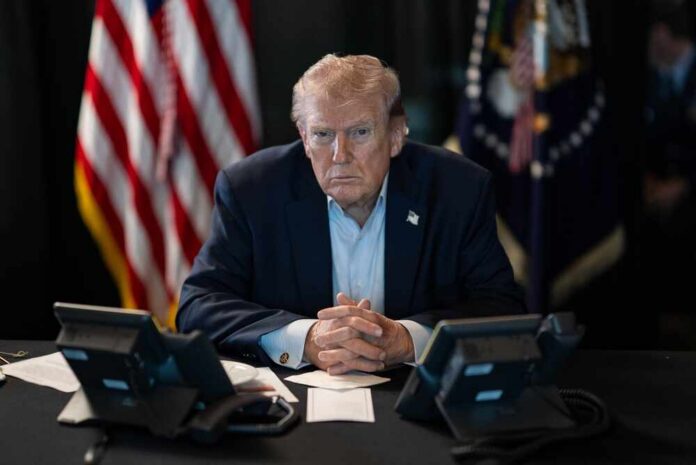
President Trump warned Iran that 1,000 missiles are “locked and loaded” and ready to strike if Tehran harms him — a stark escalation after months of naval blockades, mine-clearing operations, and direct military clashes over the Strait of Hormuz.
Story Highlights
- Trump posted on Truth Social that the U.S. has 1,000 missiles ready to “decimate and destroy” Iran if it attempts to assassinate him.
- The U.S. Navy blockade of Iranian ports began April 13, 2026, and U.S. forces actively stopped ships from reaching Iranian ports.
- The blockade was later lifted after the U.S. and Iran reached a deal, but American forces remained in the region.
- The Strait of Hormuz carries roughly 20 percent of the world’s oil, making this standoff a threat to global energy supplies.
Trump Issues Blunt Missile Warning to Iran
President Trump posted a direct threat to Iran on Truth Social, warning that the United States has 1,000 missiles “locked and loaded” and ready to fire. He said the missiles would “decimate and destroy” Iran if the regime attempts to assassinate him. The warning came as tensions between Washington and Tehran were already running hot after weeks of naval confrontations in the Persian Gulf and a breakdown in face-to-face talks between the two sides.
Iran’s supreme leader had issued his own threats, raising fears of a broader Middle East war. Trump responded by making clear that any move against him personally would bring overwhelming military force. He also declared the ceasefire “over” while saying diplomatic talks with Iran were still ongoing — a mixed signal that kept allies and enemies alike watching closely.
U.S. Navy Blockade Shut Down Iranian Ports
U.S. Central Command (CENTCOM) launched a full naval blockade of Iranian ports on April 13, 2026, at 10 a.m. Eastern Time. The order came directly after diplomacy collapsed. CENTCOM made clear the blockade targeted only ships heading to or from Iranian ports — not vessels traveling to other countries in the region. American naval forces also began clearing mines that Iran had placed in the waterway.
The blockade was enforced with real force. CENTCOM confirmed that U.S. forces disabled at least one ship that tried to reach an Iranian port in defiance of the order. The U.S. and United Kingdom also issued joint warnings to all ships in the strait. Starting in early May, CENTCOM began escorting commercial ships from neutral countries safely through the Strait of Hormuz. Britain’s prime minister called for the strait to reopen with “no conditions and no tolls.”
What’s at Stake — and How It Ended, for Now
The Strait of Hormuz is one of the most important waterways on Earth. About 20 percent of the world’s oil passes through it every day. Iran’s moves to close or charge tolls on the strait threatened to spike energy prices worldwide — hitting American consumers at the pump and in their homes. Iran had reportedly demanded payments of up to $2 million per vessel, a demand the U.S. flatly rejected as illegal under international maritime law.
🔴 Breaking:—Washington and Iran Exchange Stark Threats, Raising Fears of New Middle East Escalation!
📍WASHINGTON/TEHRAN | July 11, 2026 | HewadPress — Tensions between the United States and Iran have escalated sharply after U.S. President Donald Trump issued one of his… pic.twitter.com/72Iz4sCu36
— HewadPress (@HewadPress) July 11, 2026
CENTCOM announced in June 2026 that the blockade had ended, saying all enforcement efforts had “ceased” after the U.S. and Iran reached a deal. However, American forces stayed in the area. The deal — a Memorandum of Understanding — centered on reopening the strait, but key questions about its long-term status remain unsettled. Iran has used this chokepoint as a pressure tool for years, and with the underlying conflict unresolved, another standoff is always possible. Trump’s missile warning signals he is not willing to back down if Iran pushes again.
Sources:
cbsnews.com, stripes.com, x.com, thehill.com