
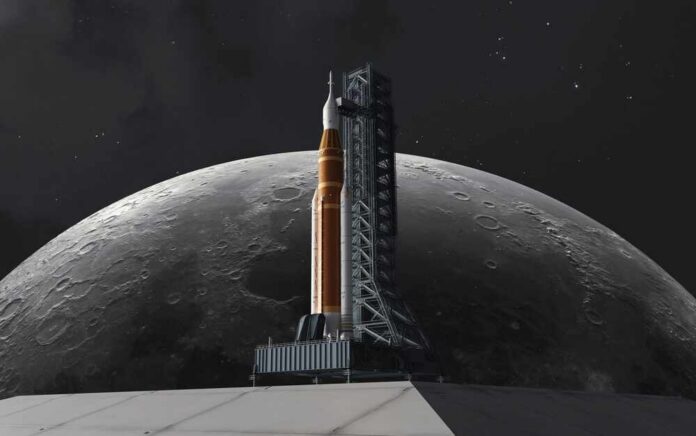
Future lunar landings could spoil some of the Moon’s best science sites before astronauts ever return there.
Quick Take
- New research says exhaust methane from lunar landers can spread to both poles fast.
- The model found methane can reach the Moon’s north pole in under two lunar days.
- More than half of the methane may settle in polar cold traps within seven lunar days.
- Scientists worry that contamination could blur clues about how life began on Earth.
What the new model found
A recent study in the Journal of Geophysical Research: Planets modeled how methane from spacecraft exhaust moves across the Moon for the first time. The researchers found that the gas does not stay near the landing site. Instead, it can hop across the airless surface and spread to both poles, where it can become trapped in frigid, shadowed areas that scientists want to study for signs of ancient organic material.
The numbers are striking. The model said methane can reach the lunar north pole in under two lunar days, no matter where the spacecraft lands. After seven lunar days, more than half of the exhaust methane had settled in polar cold traps, with about 42 percent at the south pole and 12 percent at the north pole. That is a serious problem for any mission that hopes to study untouched icy deposits.
Why the finding matters for future missions
The Moon’s polar craters are prized because they may hold water ice and prebiotic organic molecules, which are the chemical building blocks tied to life’s origin on Earth. The concern is simple: if landers spread methane into those cold traps, later instruments may have a harder time telling what came from deep space history and what came from a modern engine plume. That would weaken one of the main scientific reasons for going there.
The study’s warning is still based on a model, not on a direct measurement from a real lunar landing. That matters because the work does not prove how much methane would be enough to hide or alter ancient organic material. It also does not test different propellants, engine designs, or ways to reduce exhaust spread. Even so, the model gives mission planners a clear reason to treat contamination as a real risk, not a side issue.
What officials and mission planners need to face
American Geophysical Union coverage says the risk appears quickly and does not depend much on where a spacecraft touches down. That should get the attention of NASA, commercial lander teams, and anyone planning work near the lunar poles. If future missions are going to spend billions of dollars, they should not poison the very ground they want to study. Conservative readers will see the common-sense point: good stewardship starts before boots hit the surface.
There is also a broader lesson here about modern space policy. For years, experts have warned that spacecraft can contaminate pristine lunar environments, and earlier reports from the National Academies noted that volatile transport to polar cold traps was still poorly understood. This new methane study fills part of that gap, but it also shows how little margin there is for error when science, national prestige, and commercial schedules all collide on the Moon.
Sources:
sciencedaily.com, discovermagazine.com, linkedin.com, space.com, nationalacademies.org