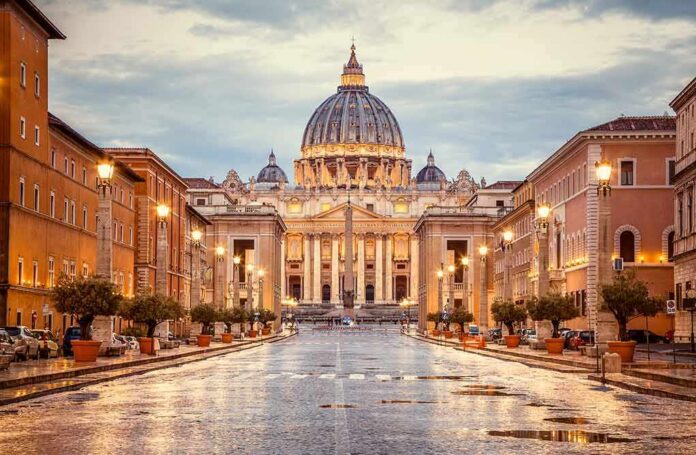
A Vatican office blocked Bishop Athanasius Schneider from offering the Traditional Latin Mass at St. Peter’s, underscoring a years-long clampdown on the ancient rite inside the basilica.
Story Highlights
- St. Peter’s Basilica has limited the traditional Latin Mass to narrow times and places since 2021.
- Pilgrims in 2023 and 2024 were denied the old rite inside the basilica during their annual visit.
- Cardinal Mauro Gambetti enforced the rules, citing decorum and centralized liturgy.
- Pope Leo XIV later allowed one Latin Mass in 2025, showing selective exceptions, not a reversal.
What Was Denied and Why It Matters
Organizers say Bishop Athanasius Schneider sought to celebrate the Traditional Latin Mass inside St. Peter’s Basilica, but Vatican officials refused, continuing a trend that began in 2021. That year, the Vatican’s Secretariat of State ordered sweeping limits on liturgies in the basilica, ending most individual Masses and restricting the older rite to the grotto-level Clementine Chapel at set times. The decision moved authority from local priests to central management, changing long-standing custom in the heart of the Church.
The clampdown reached a wider public in 2023. A large annual pilgrimage tied to Summorum Pontificum reported, for the first time, that pilgrims could not have the old rite in St. Peter’s on Saturday, the main day of their visit. The same group received the same answer in 2024, signaling a firm policy rather than a scheduling fluke. These denials show a pattern: access for the ancient rite inside the basilica moved from normal to rare, and then to nearly closed.
The Vatican’s Published Rationale Since 2021
The Vatican said the 2021 instruction aimed to preserve “recollection and liturgical decorum,” replacing many private Masses with concelebrated liturgies in a few languages. It also confined the old rite to specific times in the grottoes, away from the main altars. Cardinal Mauro Gambetti, the archpriest responsible for the basilica, later reaffirmed the rules and allowed exceptions only for groups with “particular and legitimate needs,” a high bar that many requests did not meet.
Supporters of the ancient rite argue that these limits feel unequal. They point to how quickly permissions vanished for large, peaceful groups that had come for years without incident. They also note that the policy centralizes control in ways that reduce local pastoral judgment. While the Vatican frames the rules as orderly worship, critics see a selective squeeze on tradition that sidelines a growing number of faithful families seeking reverent liturgy.
Selective Exceptions Under Pope Leo XIV
In late 2025, Pope Leo XIV permitted Cardinal Raymond Burke to celebrate a traditional Latin Mass at the Altar of the Chair, a striking allowance after two years of refusals to the pilgrim group. Reports said the Mass had the pope’s explicit approval, suggesting that exceptions can occur when the highest authority intervenes. However, the policy itself did not change. The allowance showed a case-by-case door, not a broad reopening of the basilica to the ancient rite.
Cracks in Foundation of Traditionis Custodes
Previously undisclosed documents raised serious questions about the stated rationale for Pope Francis’ 2021 decree restricting the Traditional Latin Mass. Diane Montagna
(Abridged by Robert t. Fertig with some Vital viewpoints.)
This…— Robert Thomas Fertig (@FertigsTrust) September 4, 2026
This mixed record leaves Catholics with a clear takeaway. The ordinary path remains narrow for the traditional Latin Mass in St. Peter’s, with rare exceptions granted from the top. For many faithful, that means planning around a policy built to limit, not welcome, the older liturgy. For Bishop Schneider and others, it highlights a deeper debate: whether unity means one form everywhere, or real space for tradition alongside the newer rite within the Church’s most visible shrine.
Sources:
lifesitenews.com, spzh.eu, insidethevatican.com, christianityhouse.com, clericalwhispers.blogspot.com, gloriadei.io