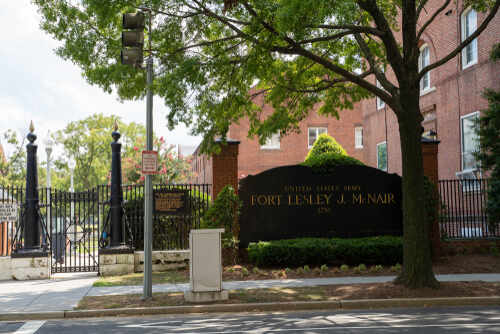
Unidentified drones over a Washington military base that houses two of President Trump’s top cabinet officials are the kind of homeland security breach Americans are tired of watching get “studied” instead of stopped.
Quick Take
- Multiple drones were detected over Fort Lesley J. McNair in Washington, D.C., where Secretary of State Marco Rubio and Defense Secretary Pete Hegseth live.
- The base briefly locked down and security officials discussed response options, including whether the two officials should be relocated.
- As of March 19, 2026, investigators had not identified the drones’ origin or intent, and Rubio and Hegseth reportedly remained at Fort McNair.
- The incident comes amid heightened U.S. security alerts tied to escalating tensions involving Iran, alongside other recent base lockdowns and elevated protection postures.
Drones Over Fort McNair Put a Sensitive Target in the Spotlight
U.S. officials detected multiple unidentified drones flying over Fort Lesley J. McNair on at least one night within the past 10 days, according to reporting that cited briefed officials. Fort McNair is a high-security Army installation in Washington, D.C., roughly two miles from the White House and Capitol Hill, and it includes housing used by senior leaders, including Marco Rubio and Pete Hegseth. The military increased monitoring and treated the incident as a serious security event.
Base leaders responded with heightened security measures that included a lockdown, and the White House convened discussions about how to handle the situation. Some options reportedly included whether Rubio and Hegseth should be temporarily relocated, though no move was ultimately carried out. The Pentagon also signaled tight operational secrecy. Spokesman Sean Parnell said the department could not comment on the defense secretary’s movements for security reasons, pushing back on detailed reporting about protectee logistics.
Why Fort McNair Is a Different Problem Than “Random Drone Sightings”
Fort McNair is not a sprawling remote base with miles of buffer space; it sits in a dense urban environment where commercial buildings, traffic corridors, and waterways complicate perimeter control. Reporting highlighted that this installation lacks the robust standoff distance seen at many other facilities, which makes low-altitude drone incursions harder to deter or quickly attribute. That reality matters because the residence locations of top officials have been publicly known since the post-2024 election transition period.
The practical issue is straightforward: drones can be cheap, hard to track, and capable of surveillance even when they are not armed. When they appear over a site tied to senior national security leadership, the question becomes less about hobbyists and more about capability and intent. Investigators have not publicly identified who flew the drones, how they were launched, or whether the flights were a probe, a stunt, or something more threatening. That uncertainty is the core vulnerability.
Heightened Alerts Elsewhere Suggest a Broader Security Strain
The Fort McNair incident landed during a period of elevated U.S. security posture linked to the U.S.-Israel-Iran conflict and related threats to American interests overseas. In the same time window, other U.S. installations reportedly tightened security, including sites raised to Force Protection Condition Charlie, a level indicating that an incident is likely or that credible intelligence suggests it could occur. Reports also described a suspicious package incident at Joint Base Lakehurst and lockdown activity at MacDill Air Force Base.
Those parallel alerts do not prove the Fort McNair drones were connected to any specific foreign actor, and the available reporting does not establish that link. Still, the overlap in timing helps explain why the response at McNair was not casual. In an era when adversaries use inexpensive technology to test boundaries, the burden is on federal authorities to show they can secure restricted airspace over critical sites—without turning every domestic incident into an excuse for sweeping new controls over ordinary Americans.
What the Public Still Hasn’t Been Told—and What Comes Next
As of March 19, 2026, the central facts remained unresolved: officials had not publicly identified the drones’ origin, the operator, or the motive, and no further sightings were confirmed in the reporting window. Rubio and Hegseth reportedly stayed at Fort McNair even after relocation was discussed. The Trump administration also had not issued a detailed public statement, leaving Americans to piece together what happened from scattered accounts citing briefed officials and limited on-the-record comment.
For many voters who watched years of “security theater” and bureaucratic drift, this incident is a reminder that government’s first job is basic protection—especially around national command leadership—without punishing law-abiding citizens. The next measurable test will be whether agencies produce a clear after-action account, tighten counter-drone defenses at urban installations, and clarify rules of engagement for drone incursions. Until then, the episode stands as an unresolved breach in the nation’s capital.
Sources:
Drones seen over military base housing Marco Rubio, Pete Hegseth
Drones seen over military base housing Marco Rubio, Pete Hegseth
Multiple drones spotted over US Army base housing top officials including Marco Rubio, Pete Hegseth