
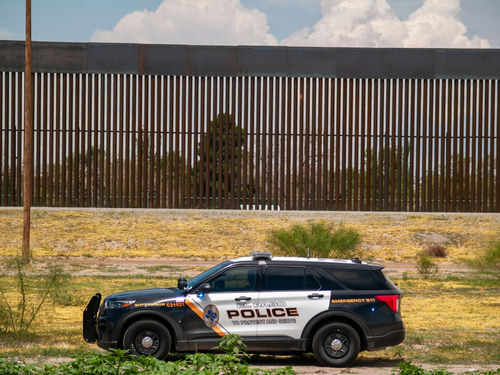
President Trump’s signature border wall project roars back to life with a federal push targeting full completion by 2028, delivering on the promise that millions of frustrated Americans watched languish under Biden’s open-border policies.
Story Snapshot
- Trump declared a national emergency in January 2025 to resume border wall construction after Biden’s prolonged pause
- DHS Secretary Kristi Noem confirms completion target of January 2028 with construction pace ramping from 2 to 10 miles per week
- Federal efforts complement Texas’ state-led construction of 82.2 miles, showcasing coordinated action against illegal immigration
- Advanced surveillance technology including sensors and cameras will accompany physical barriers across the 2,000-mile border
Trump Revives Border Security Promise Through Emergency Powers
President Trump wasted no time after his 2025 inauguration, declaring a national emergency to restart border wall construction through the State and Defense Departments. This decisive action reversed the Biden administration’s January 2021 pause that left critical gaps in border security despite ongoing migrant surges. By mid-December 2025, U.S. Customs and Border Protection averaged two miles per week, with plans to scale up to ten miles weekly. DHS Secretary Kristi Noem announced on February 10, 2026, that the department remains on track for January 2028 completion, while Parsons Government Services Inc. assumed oversight responsibilities on February 17, 2026.
Biden’s Border Failure Forced Reversal on Wall Construction
The previous administration’s ideological opposition to effective border security created predictable chaos. Biden paused all wall construction immediately upon taking office in January 2021, despite inheriting 452 miles of barriers from Trump’s first term. Surging illegal crossings and congressional funding mandates eventually forced Biden to restart limited construction in 2023, completing a mere 20 miles to fill gaps in high-traffic areas like Yuma, Arizona. This reluctant reversal exposed the hypocrisy of open-border advocates who privately acknowledged that physical barriers work. The Biden administration’s failures cost American taxpayers billions while endangering communities through unchecked illegal immigration, drug trafficking, and human smuggling.
Historical Context Reveals Bipartisan Border Security Tradition
Border barriers trace back to the 1940s-1950s under Democratic Presidents FDR and Truman, evolving from basic animal fences to sophisticated security infrastructure. George H.W. Bush approved initial barriers spanning 14-66 miles in San Diego-Tijuana between 1990-1993, while Clinton expanded operations through Gatekeeper, Hold-the-Line, and Safeguard initiatives across California, Texas, and Arizona in 1993-1994. The 2006 Secure Fence Act under President George W. Bush authorized 670-700 miles, waiving environmental regulations to complete approximately 450-652 miles by 2015. Trump’s first-term prototypes launched in 2017, with construction beginning in 2018 and reaching 452 miles by 2021, primarily replacing outdated barriers with modern steel bollard systems.
Texas Leads State-Level Border Defense Efforts
Governor Greg Abbott’s Texas demonstrated how states can protect their citizens when the federal government abandons its constitutional duty. The Texas Facilities Commission completed 82.2 miles of state-funded border barriers by August 2025, progressing from 50 miles in November 2024 under Director Mike Novak’s oversight. This state-led construction on Texas land complements federal efforts, creating a coordinated defense against illegal immigration that Biden’s policies invited. The synergy between state and federal action under Trump’s leadership shows what’s possible when elected officials prioritize American sovereignty over globalist open-border ideology that erodes national security and burdens taxpayers.
Advanced Technology Enhances Physical Barrier Effectiveness
Trump’s border wall extends beyond physical barriers to incorporate cutting-edge surveillance technology including spin cameras, facial recognition systems, and underground sensors designed to detect tunneling attempts. This comprehensive approach addresses the 1,954-mile border’s diverse terrain spanning deserts, mountains, and waterways. The integration of technology with physical barriers answers critics who claim walls alone cannot stop illegal crossings. Congressional Research Service studies noting limited effectiveness of single fences without personnel support Trump’s multi-layered strategy. The combination of barriers, technology, and border patrol agents creates the defense-in-depth approach necessary to secure America’s sovereignty and protect citizens from cartels, trafficking, and the national security threats posed by unvetted illegal crossers flooding through gaps.
Federal Contractors Mobilize Resources for Accelerated Timeline
Parsons Government Services Inc. assumed management responsibilities for federal wall completion on February 17, 2026, coordinating with CBP Chief Mike Banks to accelerate construction pace. Previous contracts allocated $3.3 billion for 218 miles during Trump’s first term, demonstrating the substantial investment required for comprehensive border security. Defense contractors and technology firms benefit economically while delivering critical national security infrastructure. Trump’s 2019 emergency declaration redirected $3.6 billion in military funds toward border construction despite congressional vetoes, establishing precedent for executive action when legislators refuse to protect American borders. The current administration’s use of emergency powers follows this legally established framework to complete what career politicians repeatedly blocked.
Sources:
Explainer: History and Future Hurdles of the U.S.-Mexico Border Wall – AS/COA
Biden’s Trump History on the Border Wall – TIME
Timeline – SMU Texas-Mexico Center
Texas Border Wall Construction Status – Texas Facilities Commission
A Brief Legislative History of the Last 50 Years of the U.S.-Mexico Border – University of Arizona