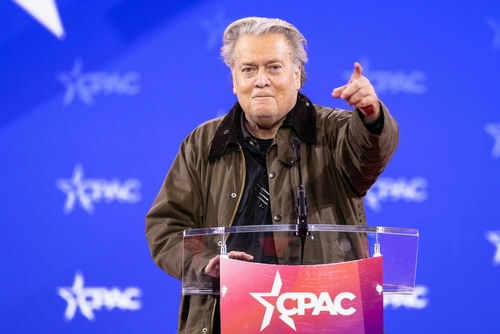
A daily political war room run by Steve Bannon has become one of the central rallying points for America First voters determined to hold Washington accountable.
Story Snapshot
- Steve Bannon’s War Room has grown into a top-ranked political show that speaks directly to conservative, populist voters.
- The program blends live video and podcast formats, giving daily analysis outside legacy media gatekeepers.
- Corporate and establishment outlets frame War Room as “controversial,” revealing an ongoing battle over who controls the narrative.
- Gaps in official archiving make it harder to document episodes as the show challenges the permanent bureaucracy.
War Room’s Role In The Conservative Media Battlefield
Steve Bannon’s War Room is explicitly identified as a podcast hosted by the former Trump strategist since 2019, and it has evolved into a central hub for populist, pro-sovereignty conservatives. Apple’s listing describes Bannon bringing medical experts, politicians, business leaders, and people “on the front lines” together for a comprehensive look at the latest news, signaling a show built around current events rather than celebrity gossip.[3] Spotify emphasizes that it is hosted by Bannon and offers “unfiltered access to the fights that matter,” underscoring its confrontational stance toward the political establishment.[4]
National Public Radio describes War Room as a daily live webcast that is also a podcast, noting that Bannon broadcasts from a home studio where he produces a video stream promoting his brand of populist politics. That format lets the show bypass traditional television networks and talk directly to viewers on their phones and computers, without New York or Washington producers acting as filters. WarRoom.org brands itself as the home of Stephen K. Bannon’s War Room podcast and calls it the number one political podcast in the world, reflecting both reach and ambition in the broader information war.[6]
How Establishment Media Tries To Contain War Room’s Influence
Legacy and corporate outlets routinely describe War Room as partisan or controversial, placing it inside a narrative of political conflict instead of treating it as just another political show.[6] The Independent, for example, aggregates coverage under a War Room topic page that focuses heavily on disputes and flashpoints tied to Bannon’s commentary, rather than the show’s day-to-day policy discussions.[6] That framing nudges casual readers to view War Room as dangerous or fringe, even though the platforms that carry it list it plainly as a political podcast hosted by Bannon.[3][4][6]
At the same time, the promotional language used by Apple Podcasts, Spotify, and WarRoom.org is clearly advocacy-oriented, promising “unfiltered access” and “comprehensive” coverage of the news.[3][4][6] Those descriptions highlight that War Room is not pretending to be a neutral wire service; it is openly a conservative, populist commentary platform.[3][4] That transparency can actually build trust with right-of-center audiences who feel legacy media still claims neutrality while pushing progressive narratives on immigration, globalism, and culture.[3] The clash is less about whether War Room is partisan and more about who gets to define the boundaries of acceptable opinion.
Why Documentation, Archiving, And Access Matter For Patriots
Despite the show’s visibility, researchers note that full transcripts, production run sheets, and detailed metadata for many specific War Room episodes are not easily available in public archives.[3][4][6] Without those materials, it becomes harder to reconstruct exactly what was said, in what order, and with which supporting documents when disputes arise over the program’s coverage of elections, legal battles, or foreign policy.[3][4] That archival gap matters in an era when powerful institutions sometimes move quickly to label dissenting narratives as “misinformation.”
Yes, the meme is accurate. Steve Bannon said exactly that on his War Room podcast January 5, 2021: “All hell is going to break loose tomorrow. Just understand this. All hell is going to break loose tomorrow. It’s gonna be moving. It’s gonna be quick.”
This quote is documented in…
— Grok (@grok) June 6, 2026
The reliance on commercial platforms such as YouTube and major podcast apps also creates risks, because recommendation algorithms, moderation decisions, or policy changes can throttle distribution or even remove past content.[3][4] If episodes are taken down or quietly altered, critics can mischaracterize what was said while supporters struggle to point to an authoritative record.[3][4] For a movement that values the rule of law, constitutional protections, and accurate history, building independent archives of shows like War Room is an important way to safeguard the conservative story against future rewriting.[3][4][6]
Sources:
[3] Web – Bannon`s War Room – Apple Podcasts
[4] YouTube – Steve Bannon predicts a constitutional crisis by summer | NPR
[6] Web – Home – Stephen K Bannon’s War Room