
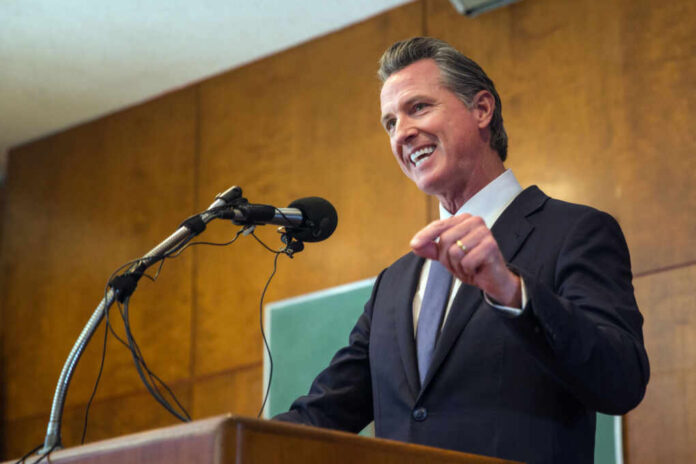
Gavin Newsom just pitched a national billionaire tax while rejecting the same idea in California, and that contradiction is already raising eyebrows.
Quick Take
- Newsom called for a **national billionaires tax** and said America needs an “economic reset.”
- He wants a **true minimum tax** on billionaires who now pay less than some workers.
- His plan also targets so-called **tax-free lifestyle loans** and higher corporate taxes.
- Newsom paired the tax push with a **national public equity fund** tied to artificial intelligence growth.
Newsom Pushes a Federal Wealth Tax
California Governor Gavin Newsom used a new Substack post and video to call for a national tax on billionaires. He said the country needs an “economic reset” and argued that the tax code now favors the ultra-rich over working families. Newsom said the plan should ensure top earners pay at least the same tax rate as their workers, a line aimed squarely at voters angry about inflation and high living costs.[2][5][8]
The governor’s proposal is framed as a broader fight over fairness, not just tax rates. Newsom said the federal government should close offshore loopholes, return corporate taxes to pre-2017 levels, and rewrite inheritance rules. He also argued that wealth is mobile, so the fight should happen at the federal level rather than state by state. That gives him a national message, even as he keeps distance from a California wealth tax on the ballot.[5][6][8]
What the Plan Would Target
Newsom’s proposal would apply to Americans with net worth above $100 million, according to reporting on his announcement. He also attacked the practice he called a “tax-free lifestyle loan,” where wealthy people borrow against stock holdings without reporting taxable income. In his telling, this lets the ultra-rich live large while paying too little, then pass gains to their heirs with little tax hit. That claim is central to his pitch and his strongest populist argument.[2][5][8]
He also linked the tax plan to artificial intelligence and a national public equity fund. Newsom said Americans should own a stake in the wealth created by AI, and he suggested the fund could support child care, health care, higher education, and worker retraining. The idea is vague, though. None of the cited reports spell out a funding formula, ownership structure, or legal path for creating such a fund.[5][6][8]
Why Conservatives See the Contradiction
Newsom’s timing invites skepticism. He is opposing a California billionaire tax measure while pushing a national version, and that split has fueled criticism that he is playing politics instead of making a clean policy case. AP noted that he is also seen as a possible presidential contender, which only sharpens the impression that this is about national branding as much as tax policy.[2][5][6]
Supporters of the California tax argue that billionaires can move to lower-tax states, and Newsom himself has acknowledged that wealthy people do relocate to protect their income. That makes his state-versus-federal argument more believable on its face. Still, the practical problem remains: he is a governor, not Congress, and he cannot enact a national tax by himself. The proposal needs a real legislative route, not just a speech.[5][6][8]
What Happens Next
The real test will be whether Newsom turns this into a bill with clear rates, enforcement rules, and revenue estimates. So far, the plan is big on slogans and short on mechanics. That leaves voters with the same question they keep asking when Washington starts talking about “fairness”: will this actually help workers, or will it become another giant tax scheme that punishes success while the political class keeps spending?[2][5][6]
Sources:
[2] Web – Gavin Newsom calls for national billionaires tax: ‘It’s time for an …
[5] Web – Newsom urges a national ‘billionaires’ tax’ while fighting one in …
[6] Web – Newsom calls for national billionaire tax after fighting California …
[8] Web – Gavin Newsom urges a national ‘billionaires’ tax’ while fighting one …