
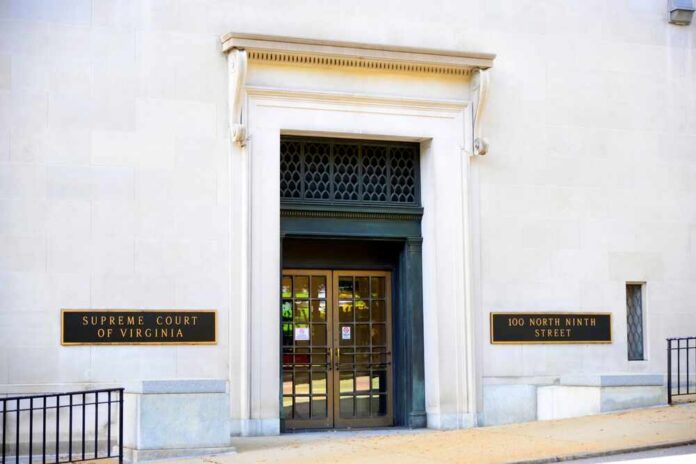
Virginia’s Supreme Court just dealt Democrats a crushing blow, striking down their scheme to flip four congressional seats through mid-decade redistricting that voters barely approved—preserving Republican control as the 2026 midterms loom.
Story Snapshot
- Virginia Supreme Court ruled 4-3 to invalidate a Democratic redistricting amendment that would have shifted the map from 6D-5R to 10D-1R
- Court cited a constitutional violation: Democrats approved the ballot measure during early voting for the 2025 election, breaching procedural rules
- The NRCC-funded legal challenge preserves the current map, blocking a potential four-seat Democratic gain ahead of 2026 midterms
- Democrats vow to appeal to the U.S. Supreme Court, arguing the ruling overrides the will of Virginia voters
Court Strikes Down Mid-Decade Power Grab
The Virginia Supreme Court ruled on May 8, 2026, that the Democratic-led General Assembly violated the state constitution by approving a redistricting amendment during early voting for the 2025 general election. Justice D. Arthur Kelsey authored the 4-3 majority opinion, which found the timing breached procedural safeguards designed to prevent last-minute electoral manipulation. The amendment, narrowly approved by voters in April 2026, would have redrawn Virginia’s congressional map to favor Democrats 10-1, up from the current 6D-5R split established after the 2020 census. Chief Justice Cleo Elaine Powell dissented, arguing the procedural violation did not warrant nullifying the voter-approved measure.
The ruling came as Republicans nationwide celebrate momentum from recent Supreme Court decisions limiting the Voting Rights Act, emboldening GOP-led states to defend or redraw maps in Florida, Tennessee, South Carolina, Louisiana, and Alabama. The National Republican Congressional Committee, which funded the Virginia legal challenge, framed the decision as restoring fairness against what Chair Richard Hudson called a “corrupt scheme” to rig House seats. For many conservatives, the outcome underscores concerns that Democratic officials prioritize partisan advantage over constitutional norms, exploiting voter referendums to bypass standard redistricting processes after independent commissions failed to produce maps acceptable to the party.
Political Fallout and National Implications
The decision preserves five Republican congressional seats that would have been eliminated under the Democratic map, directly impacting the GOP’s slim House majority as the 2026 midterms approach. NRCC Chair Richard Hudson declared Republicans “on offense,” citing the ruling as proof that Democrats cannot gerrymander their way to power. Meanwhile, Virginia’s Democratic Attorney General announced the state is “evaluating every legal pathway forward to defend the will of the people,” signaling an imminent appeal to the U.S. Supreme Court. The clash highlights a broader national battle: Democrats accuse Republicans of manipulating maps in Southern states post-VRA rulings, while Republicans counter that this Virginia effort—backed by former President Obama’s redistricting advocacy—represents overreach cloaked in populist rhetoric.
The procedural violation at the heart of the ruling raises questions about mid-decade redistricting tactics nationwide. The Democratic-led General Assembly pushed the amendment through during early voting, a move the court deemed fundamentally incompatible with constitutional requirements for fair referendum procedures. Critics on the right argue this exposes a pattern of Democratic leadership circumventing established rules when convenient, undermining public trust in electoral institutions. For voters on both sides frustrated with government dysfunction, the spectacle of politicians manipulating district lines—whether by technical violations or partisan redrawing—reinforces the perception that elected officials care more about securing their jobs than serving constituents.
Broader Redistricting Wars and Voter Frustration
This ruling fits into a larger redistricting war playing out across America, where both parties accuse each other of gerrymandering while the average citizen watches powerless. Virginia’s experience mirrors Texas GOP efforts cheered by Republicans before the state’s 2026 vote, and Democrats’ failed attempts to counter Republican advantages in Southern states following Supreme Court limitations on federal intervention in redistricting under cases like Rucho v. Common Cause in 2019. The result is a patchwork of maps drawn by whichever party controls state legislatures, with little regard for competitive districts or genuine representation. Voters narrowly approved Virginia’s amendment in a special election, yet the court overrode that decision on a technicality, leaving many questioning whether their votes matter when judges or politicians can nullify outcomes.
CNN Melts Down After Virginia Supreme Court Nukes Democrats’ Gerrymandered Maphttps://t.co/fKpGgQHY5N
— PJ Media (@PJMedia_com) May 9, 2026
The long-term implications extend beyond Virginia. If the U.S. Supreme Court upholds the state court’s ruling, it could set a precedent discouraging similar mid-decade redistricting shortcuts in other states, potentially shaping how legislatures approach ballot measures tied to election timing. For conservatives, the decision represents a rare judicial check on Democratic overreach and a defense of constitutional procedure. For liberals, it exemplifies how technical rulings can disenfranchise voters and entrench GOP advantages, fueling distrust in courts perceived as partisan. Both sides agree on one thing: the redistricting process remains a battleground where the powerful manipulate rules to stay in power, leaving ordinary Americans sidelined in a system increasingly detached from the founding principle of government by the people.
Sources:
Virginia Supreme Court strikes down voter-approved redistricting plan – WJLA
Virginia redistricting 2026 election overturned – Politico
VA redistricting referendum shows peril SCOTUS gerrymandering rulings – Brennan Center