
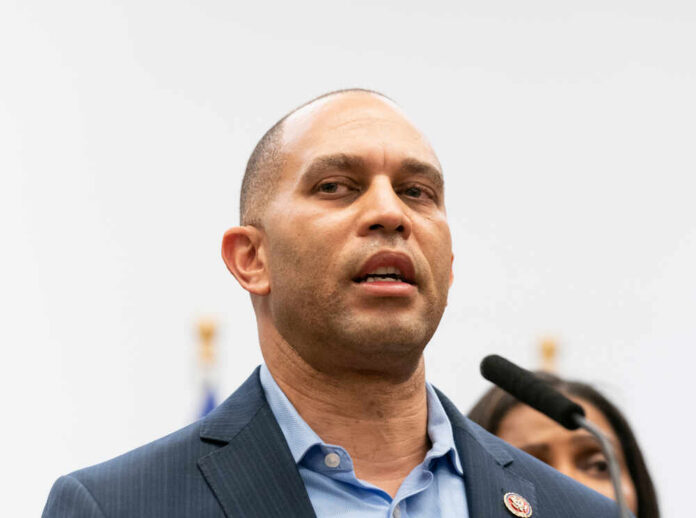
Democrats are openly floating ways to “do something” about the Supreme Court—raising fresh fears that Washington will rewrite the rules when rulings don’t go their way.
Story Snapshot
- House Minority Leader Hakeem Jeffries called the Court’s conservative majority “illegitimate” after an April 29, 2026 ruling that narrowed Voting Rights Act protections.
- Jeffries said “everything was on the table” on court “reform,” language Republicans interpret as signaling court expansion and procedural escalation.
- Democratic-aligned proposals discussed in recent years include expanding the Court to 13 or 15 justices and imposing term limits, though details remain contingent on election outcomes.
- Republicans argue the rhetoric undermines confidence in the judiciary, while Democrats frame it as a response to major shifts in voting-rights jurisprudence.
Jeffries Escalates the Legitimacy Fight After Voting Rights Ruling
Hakeem Jeffries, the House Democratic leader, sharpened Democratic attacks on the Supreme Court after a major April 29, 2026 decision that limited protections under the Voting Rights Act. In a public statement, Jeffries labeled the conservative majority “illegitimate” and repeatedly tied the ruling to President Trump’s judicial appointments by calling it “the Trump Court.” The language landed in the middle of an election year, when control of Congress will determine what, if anything, lawmakers can do next.
Jeffries’ rhetoric did not emerge in a vacuum. Democrats have been building a broader narrative that the Court’s recent voting-rights decisions, combined with the post-2020 census redistricting cycle, are reshaping election rules in ways they view as unfair. Jeffries has also emphasized that voting and redistricting disputes have followed him throughout his political career, adding a personal edge to the argument that the Court is now central—not peripheral—to day-to-day political power.
What the April 29 Decision Changed—and Why It Became a Flashpoint
The April 29 ruling is described in reporting as further limiting Section 2 of the Voting Rights Act, adding to a longer trajectory that includes the Supreme Court’s 2013 Shelby County v. Holder decision. The new decision intensified the national argument over how courts should evaluate claims of racial discrimination in voting rules and district maps. In the research provided, the majority opinion is attributed to Justice Samuel Alito and is described as skeptical of race-conscious government decision-making.
For conservatives, the dispute taps into a core separation-of-powers concern: courts exist to interpret the Constitution and statutes, not to produce outcomes tailored to one party’s electoral goals. For liberals, the dispute is framed as an urgent voting-rights emergency that calls for legislative fixes like the John Lewis Voting Rights Advancement Act. What makes the moment combustible is that both sides are signaling institutional escalation—Democrats with “reform” talk, and Republicans with warnings about the filibuster and long-term control of federal courts.
Court “Reform” vs. Court “Packing”: The Proposals Driving the Suspicion
Jeffries’ statement that “everything was on the table” has been interpreted by Republicans as an invitation to expand the Court, even if Jeffries did not publish a specific bill with numbers attached. The research notes that Democratic-sponsored ideas discussed in recent years include expanding the Supreme Court to 13 or 15 justices and adopting term limits, often framed as measures to restore “integrity, accountability, and trust.” President Trump, however, has claimed Democrats want 21 justices—an assertion the research flags as inaccurate.
The practical issue is straightforward: changing the size of the Supreme Court is legally possible through legislation, but politically explosive because it would invite tit-for-tat retaliation whenever power flips. For voters already convinced Washington’s “elites” protect their own interests, that kind of institutional arms race looks less like reform and more like rules manipulation. Even when framed as “accountability,” proposals that appear designed to change outcomes can erode the belief that courts are independent from party machines.
The 2026 Midterms Put the Court in the Crosshairs of Everyday Politics
Democrats cannot enact court changes without winning power, which is why the November 2026 midterms loom over every statement. Jeffries is widely viewed as a likely Speaker if Democrats regain the House, and he has said voting-rights legislation would be a priority. Republicans, meanwhile, are using Democratic rhetoric to rally their base around defending the Court and warning about procedural hardball, including claims that Democrats would weaken or eliminate the filibuster to push institutional changes through the Senate.
Jeffries' New Statement About Courts Shows Just How Off the Rails Dems Arehttps://t.co/kTjFO0Fn4S
— RedState (@RedState) May 11, 2026
What remains unclear from available public detail is where Democratic leadership draws the line between messaging and concrete legislative intent. Jeffries’ own words show anger at the ruling and a willingness to consider major changes, but the research does not provide a specific bill text or a whip count to prove a unified plan. Still, the political signal is real: the Supreme Court is no longer treated as a stabilizing referee by large parts of the political class, but as a prize to be won—and that should worry Americans across the spectrum.
Sources:
https://pueblostarjournal.org/news/2026/05/04/supreme-court-limits-voting-rights-act/