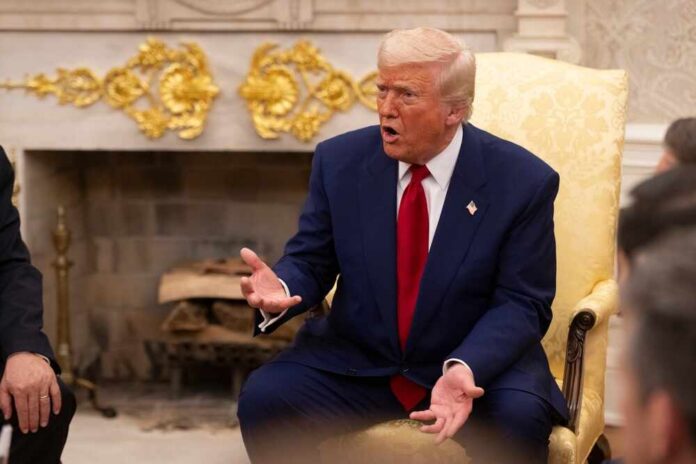
A narrowly divided House just voted to clip President Trump’s war powers on Iran, giving Democrats and war-weary Republicans a symbolic win while doing nothing to truly end the conflict or make America safer.
Story Snapshot
- The House passed a war powers resolution 215–208 to restrict President Trump’s ability to continue military action against Iran.[2][3]
- Four Republicans joined Democrats, handing the left a symbolic rebuke of the president’s foreign policy.[2][3]
- The measure is largely symbolic, still needs Senate action, and can be vetoed, so it does not actually end the Iran conflict.[2][4]
- The vote highlights a deeper fight over who controls war powers and whether Congress is serious about border security and real threats instead of political theater.[2][3][4]
House Pushes Symbolic Check On Trump’s Iran Policy
The United States House of Representatives voted 215–208 to approve a war powers resolution aimed at halting President Donald Trump’s authority to continue military action against Iran, with four Republicans breaking ranks to vote with Democrats.[2][3] News coverage describes the measure as directing the president to remove United States forces from hostilities with Iran or seek explicit congressional authorization before further strikes.[1][2] Journalists note this was the first time the House successfully advanced such an Iran-focused war powers measure after several failed attempts.[2][3][4]
Reporters emphasize that the resolution is a political setback for Trump, framing it as a congressional “rebuke” or blow to his handling of the three‑month conflict with Iran.[2][3] Commentators repeatedly stress that members opposed what they characterize as an “illegal” or unauthorized war, echoing progressive claims that Congress must reassert its constitutional role in matters of war and peace.[1] At the same time, coverage acknowledges that the White House has insisted a ceasefire is already in place and that hostilities have ceased, complicating the narrative that Congress just “ended” an active war.[2]
What The Resolution Really Does — And Does Not Do
Analysts across outlets agree that, on its own, the House vote does not immediately stop the Iran conflict or force operational withdrawal of United States forces.[2][4] The measure is a concurrent war powers resolution, meaning it still requires Senate approval, and even then President Trump could veto any binding legislation that attempted to strip his authority as commander in chief.[2][4] Reports describe the House action as “largely symbolic,” intended more to send a message about limits on presidential war powers than to impose an immediate halt to operations.[2][4]
Coverage of the floor debate underscores that both parties invoked the Constitution but drew different conclusions about how far Congress should go.[2][4] Supporters argued that only Congress can declare war and that continued force against Iran without explicit authorization overstepped that boundary.[2][3] Opponents countered that Iran and its proxies, including Hezbollah, are driving regional instability and that restricting the president now could hamstring the United States and its allies in deterring attacks, particularly against Israel.[3][4] None of the reporting includes a formal legal ruling resolving this constitutional tension, leaving the practical effect of the resolution uncertain absent further action.[2][4]
Conservatives Weigh Principle Of Restraint Against Real-World Threats
The House Clerk’s official roll call confirms the 215–208 tally and identifies the vote as taken under the War Powers Resolution, reflecting longstanding battles over how far Congress can go in directing troop deployments. For constitutional conservatives, the episode puts two core principles in tension: the need to reassert legislative authority on war decisions and the need to avoid performative votes that do not genuinely strengthen national security. The current measure resembles earlier “signal” resolutions that express disapproval without guaranteeing meaningful changes on the ground.[2][4]
BREAKING: US House votes to end Iran war in rebuke to Trump as indirect talks continue amid regional tensions. Iran reports no major progress. Developments ongoing. #IranWar #Ceasefire #BreakingNews pic.twitter.com/JLEHSKvTod
— Globe news (@Globenews34) June 4, 2026
Reporting notes that similar efforts have repeatedly emerged when presidents of both parties conduct extended military operations without new authorizations, suggesting a pattern of Congress reacting late rather than setting clear, durable boundaries.[2][4] At the same time, the vote comes as many Americans remain frustrated that Washington moves faster to limit force abroad than to secure the southern border, reduce spending, or tackle inflation at home. The mixed motives in this latest Iran vote—part constitutional assertion, part partisan messaging—leave open whether lawmakers will follow symbolism with serious, consistent reform of war powers and foreign commitments.[1][3]
Sources:
[1] YouTube – House votes to end war in Iran in a political blow to President Donald …
[2] YouTube – House votes to rein in Trump’s military action against Iran
[3] YouTube – US House votes for measure that would end Iran war
[4] Web – Iran vote caps Trump’s congressional losing streak – POLITICO