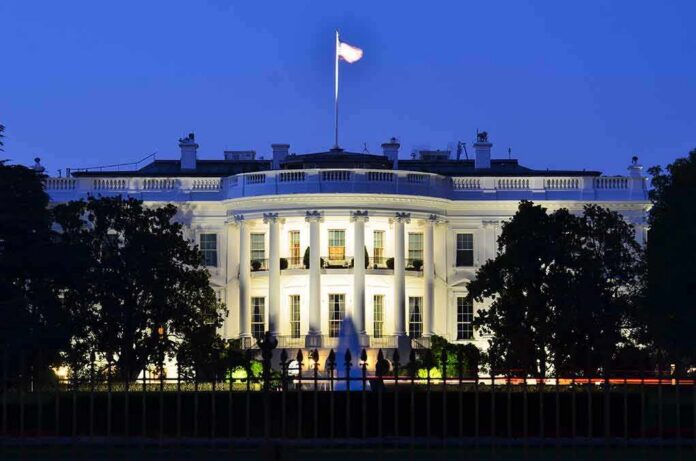
A Tucson man has been charged after a chilling email threatened bombs around the White House within 12 hours, prompting a rapid federal response.
Story Snapshot
- Federal prosecutors charged a Tucson resident with making an interstate threat tied to a bomb warning against the White House.
- The email sent to a Tucson TV station warned of bombs around Washington, D.C., claiming an imminent strike.
- Investigators say they identified the alleged sender and found similar unsent draft threats to other outlets.
- The charge falls under the federal statute for interstate threats transmitted by electronic communication.
Federal Charge Alleges Interstate Bomb Threat
The United States Attorney’s Office for the District of Arizona announced that Jacob Aaron Hicks, 46, of Tucson, was arrested and charged by criminal complaint. Prosecutors say the complaint alleges he sent an email on September 23, 2026, threatening a bombing near the White House. The charge is making an interstate threat to injure, a federal crime that covers threats sent across state lines by electronic means. The filing marks the start of the federal case, not a conviction.
The alleged message was sent to the newsroom at KGUN9 in Tucson, which then notified law enforcement. The text warned that a strike would occur within 12 hours and claimed bombs were placed around Washington, D.C. The wording declared, “This is not a joke,” and invoked “Allah,” escalating urgency. Station involvement created a record and helped launch the investigation. Prosecutors say investigators traced the message back to the accused sender.
Investigators Link Account And Find Similar Drafts
The Department of Justice said investigators identified Hicks as the alleged sender after the television station alerted authorities. Agents also reported finding multiple unsent draft emails dated the same day. Those drafts were addressed to other news agencies and contained similar threats aimed at the White House and nearby areas. That detail suggests planning beyond a single message, though the drafts were not transmitted. Officials credited the quick media tip for speeding the probe.
Reporters at ABC15 said the Federal Bureau of Investigation confirmed the forwarded email triggered the investigation that led to the arrest. That report tracks with the timeline provided by prosecutors. The focus is on the electronic trail and the content’s direct reference to federal targets in Washington, D.C. That interstate link is central to the charging theory. The case now moves to court, where the government must prove who sent the email and with what intent under the law.
Law And Security: Where Free Speech Ends And True Threats Begin
Federal courts have held that the statute for interstate threats, 18 United States Code section 875(c), punishes “true threats,” not mere hyperbole. Recent rulings explain that juries must find the message would be seen as a real threat and that the defendant sent it with the needed mental state. In July 2026, the United States Court of Appeals for the Ninth Circuit affirmed a conviction under this law and explained those elements in detail.
Tucson Man Criminally Charged for Bomb Threat Against the White House
Jacob Aaron Hicks, 46, of Tucson, was arrested yesterday and charged by criminal complaint with Making an Interstate Threat to Injure. Hicks is accused of sending an email on Sep.23, 2026, threatening to… pic.twitter.com/peLomtfTWX
— FBI Phoenix (@FBIPhoenix) October 9, 2026
Public safety agencies treat threats to the White House and federal property as top tier. Under President Trump, the expectation is firm: take threats seriously, move fast, and protect the seat of government. This case shows that approach. A local station alerted authorities, federal agents traced the message, and prosecutors charged the suspect. That chain reinforces a simple standard most Americans support: free speech is vital, but threats to kill or bomb cross a bright legal line.
Sources:
redstate.com, radaronline.com, yahoo.com, azcentral.com