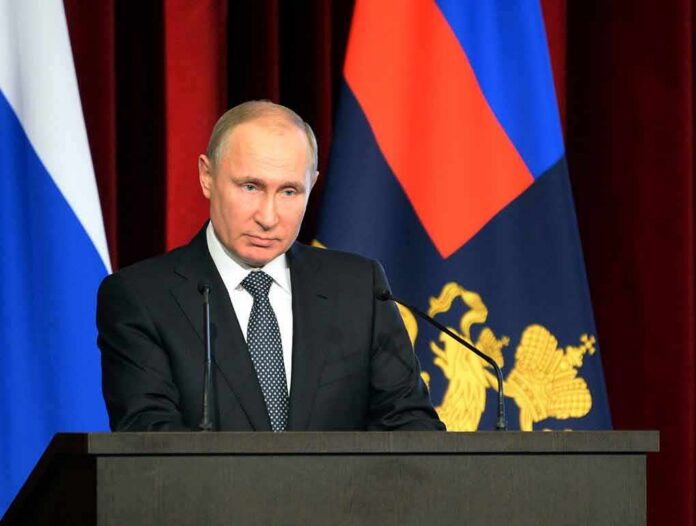
Russian President Vladimir Putin told Britain and France to stop shielding their allies with nuclear weapons if they want peace in Ukraine, a demand that has London and Paris digging in instead of backing down.
Story Snapshot
- Putin repeated his demand that Ukraine drop its NATO bid and hand over claimed territory as the price of peace.
- The Kremlin has pressured the UK and France to pull back their nuclear protection of allies.
- Britain and France say they will not be scared off by Russian nuclear rhetoric.
- NATO’s leader says Putin has “no veto” over who joins the alliance in the future.
- The standoff comes as President Trump pushes for a deal to end the war.
Kremlin Repeats Its Price for Peace
At his December press conference, Putin said he was ready to end the war, but only on the terms he first laid out in June 2024. Those terms require Ukraine to give up any hope of joining NATO and to withdraw from four regions Russia claims as its own. Moscow has also said it will treat troops from NATO countries stationed in Ukraine as a “legitimate target”, a warning meant to keep Western forces far from the front.
Putin insists these conditions address the “root causes” of the war, not just battlefield gains. He says Russia holds a position of strength and sees no reason to compromise further. Critics note the same terms demand Ukraine abandon land his forces do not fully control, which looks less like a security fix and more like a land grab dressed up as peace.
London and Paris Reject Russian Pressure
Britain and France answered Moscow’s nuclear pressure with a joint statement making clear they will not blink. Both countries said they are “resolved to deter threats against Europe” and “will not be intimidated by Russian nuclear rhetoric,” adding that the UK’s deterrent stays committed to defending all of NATO. That is a direct rebuke of any Russian hope that nuclear threats could split the alliance apart.
Britain has also doubled down on backing Kyiv rather than pulling back. The UK government says it has committed more than £35.5 billion to Ukraine since the war began, including £16.5 billion in military support, and will keep supporting Ukraine until Kyiv itself believes any peace deal is safe. That is not the posture of a country looking to cave to Kremlin demands.
NATO Alliance Pushes Back on Moscow’s Veto Claim
NATO Secretary General Mark Rutte has drawn a hard line against Putin’s core demand. Speaking in Davos, Rutte said plainly that Putin “has no veto and has no vote on whoever would join NATO in the future”. European Union foreign policy chief Kaja Kallas echoed that stance, saying Russia has no veto over European security and that Moscow, not the alliance, keeps breaking the treaties meant to keep the peace.
Polish Foreign Minister Radoslaw Sikorski went further, warning that any deal over Ukraine’s future cut together without European nations at the table “would not just be unwise” but “impossible”. That message matters for American readers wary of foreign entanglements decided behind closed doors, since it shows Europe is not waiting on Washington or Moscow to settle its own fate.
Years of NATO Expansion Fuel the Standoff
This fight did not start overnight. Scholars have argued for decades over whether NATO’s growth toward Russia’s border provoked Moscow or whether Putin simply resents losing influence after the Soviet collapse. The research shows no agreement on which explanation carries more weight, but it does show Russia has used that grievance consistently to justify demands on Ukraine and now on Britain’s nuclear posture.
Vladimir Putin has told the UK and France to stop using their nuclear weapons to defend their allies if it wants peace in Ukraine. So, where is the warning for the United States, which also protects Europe with its nuclear umbrella as part of NATO? Did Trump secretly cut a deal… pic.twitter.com/yEQx6tOomr
— The New York Independent (@nyi_news) November 15, 2026
President Trump has signaled interest in direct contact with Putin as part of a broader peace push, even as Moscow “plays hardball” on the terms it will accept. For conservatives who want an end to endless war funding but also want America’s allies to stay strong and sovereign, the test now is whether Trump can get Putin to the table without the United States or Britain surrendering the nuclear deterrence and alliance commitments that have kept the peace for decades.
Sources:
express.co.uk, reuters.com, president.gov.ua, nato.int, freep.com, gov.uk