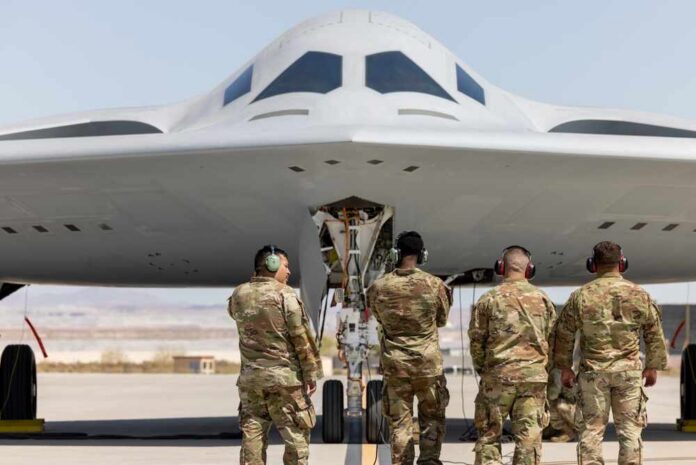
America’s new B-21 Raider is emerging from secrecy just as Washington’s biggest test—deterring China and Russia without breaking the budget—collides with public distrust in federal priorities.
Story Snapshot
- The Air Force’s B-21 Raider has moved from public rollout to flight testing, including a second aircraft’s first flight as the program accelerates.
- The bomber is designed for high-end threat environments and is intended to replace aging bombers while supporting nuclear deterrence and conventional missions.
- Officials say the B-21’s range, stealth, and maintainability aim to reduce reliance on overseas basing and heavy logistics in a crisis.
- Congress is funding a long-term modernization effort as the Air Force targets at least 100 aircraft, with service entry expected in the early 2030s.
From “Public Debut” to Real Flight Tests
The B-21 Raider first appeared publicly at a December 2022 ceremony at Northrop Grumman’s Palmdale, California facility, ending years of tight-lipped development. The program then hit a more consequential milestone when the aircraft began flying test sorties, including a second B-21 completing its first flight as the Air Force pushes to build momentum in the test campaign. Most performance details remain classified, but the timeline signals the bomber is moving beyond staged rollout moments.
The Raider matters because it is not simply a new airframe; it is intended to modernize the backbone of long-range strike after decades without a new bomber entering service. The Air Force has framed the B-21 as a successor effort to the B-1 and B-2, while the venerable B-52 remains part of the future force mix. For taxpayers, the key question is whether faster testing translates into on-time delivery rather than another expensive schedule slip.
Why the B-21 Is Built for a Harder World
Air Force planning for the B-21 centers on “high-end threat” conditions—precisely the kind of scenario posed by advanced air defenses tied to major powers like China and Russia. That reality is why the bomber’s stealth and survivability are treated as core features, not luxuries. The aircraft is also expected to handle intelligence, surveillance, and reconnaissance roles in addition to strike missions, reflecting the Pentagon’s drive for platforms that can do more than one job in contested airspace.
Defense leaders have also emphasized flexibility: the B-21 is described as capable of shifting from gathering intelligence to supporting broader battle management tasks. That concept aligns with a modern warfare problem conservatives often highlight—America cannot assume permissive access, cheap basing, or unchallenged air superiority forever. If the bomber can operate with less dependence on overseas bases and complex logistics, it could reduce vulnerability to political constraints abroad and sudden disruptions during a fast-moving crisis.
The Deterrence Mission—and the Limits of What the Public Can See
The B-21 is designed to be dual-capable, serving as a nuclear and conventional strike platform and reinforcing America’s nuclear deterrent triad. Because much of its mission equipment and signature-management technology remains classified, public debate is inevitably constrained to program milestones, basing plans, and broad capability claims. That secrecy is normal for strategic systems, but it also fuels suspicion across the political spectrum that federal programs can hide overruns or underperformance until it’s too late for meaningful oversight.
The Air Force has stated a minimum acquisition target of 100 aircraft, with operational service expected in the early 2030s. Communities tied to future basing—such as locations identified for B-21 operations—have an obvious stake in the program’s stability. At the national level, the bomber’s progress raises a straightforward governance issue: Congress must balance the need for credible deterrence with the public’s demand that the Pentagon avoid open-ended spending that worsens debt and crowds out domestic priorities.
A Stress Test for Government Credibility on Defense Spending
The B-21’s development comes at a time when many Americans—left and right—believe federal institutions protect insiders better than taxpayers. The Pentagon’s emphasis on delivering the Raider “on time and on budget” reflects that political reality as much as it reflects engineering discipline. For conservatives frustrated by decades of overspending and bureaucratic drift, the best outcome is a weapons system that restores deterrence while demonstrating that government can still execute a complex program without waste.
The program’s next inflection point will be whether accelerating flight tests leads to steady, measurable progress integrating weapons and mission systems. Until more is declassified, citizens should treat flashy imagery cautiously and focus on verifiable markers: additional test aircraft, transparent schedule updates, and procurement decisions that match stated strategy. If the B-21 meets its goals, it could strengthen deterrence for a generation; if it falters, it will validate the growing bipartisan belief that Washington struggles to deliver results.
Sources:
America’s new stealth B-21 Raider takes next step with second bomber’s first flight
B-21 Raider Has Flown For The First Time