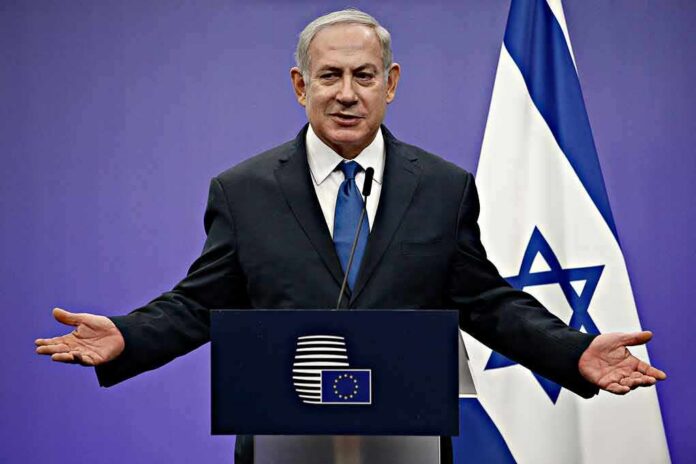
Benjamin Netanyahu vowed to form a “strong right-wing government” even as Israel’s election delivered no clear majority.
Story Highlights
- Netanyahu said he will build a strong right-wing government, calling Likud the largest party.
- Exit polls showed both blocs short of the 61-seat majority needed to rule.
- Broadcasters reported tight, varying projections between pro- and anti-Netanyahu camps.
- Netanyahu tied his security agenda to work with President Trump against Iran.
Netanyahu Declares Push for a Right-Wing Coalition
Benjamin Netanyahu told supporters that he would build a “strong government of the right,” and said his Likud party stood as the largest in Israel’s vote. He spoke after polls closed, while ballots were still being counted. His message stressed stability and security, and it set a clear goal for talks with allied parties. The pledge came as early counts and projections showed a close race without a winner, keeping attention on coalition math rather than party size alone.
Netanyahu linked his case to national defense and the fight against Iran. He said Israel had a “unique opportunity” with President Trump to end what he called the Iranian threat. That framing matched his long-standing stance on hard power and deterrence. It also signaled that security, not political theater, would drive his outreach to right-leaning and religious parties as he seeks enough partners to secure a governing majority in the Knesset.
Exit Polls Show No Majority, Keeping Power in Play
Exit polls from major broadcasters showed both blocs short of the 61 seats needed to govern in Israel’s 120-seat parliament. One channel placed Netanyahu’s bloc narrowly ahead, while others showed a tie between the camps. Such splits underscored a familiar pattern in Israel’s system, where parties win seats by share of vote and coalitions form later. The gap between largest party and governing control therefore remained the key hurdle for either side to clear.
Initial coverage from international outlets echoed the message of uncertainty. Reports highlighted that neither bloc reached a majority and that seat counts varied by projection. Some reports placed the Netanyahu camp at 50 to 52 seats, with the opposition close behind or level. Those figures kept attention fixed on potential partners and red lines among smaller parties. Officials also noted that preliminary numbers could shift as counting and checks continued.
Largest Party Claim Boosts Negotiating Leverage
Likud’s standing as the largest party gave Netanyahu a simple, strong talking point as he started coalition talks. Broadcaster tallies that showed Likud on top helped frame him as the natural first mover, even without a clear path to 61. That status can draw fence-sitting partners and shape public expectations during bargaining. But it does not replace the need to stitch together a majority across right-leaning and religious allies who must agree on policy and posts.
Despite months of unfavourable polling, Likud is emerging as Israel’s largest party —and Netanyahu’s bloc is the biggest party leading the initial count! His political resilience has proved greater than many anticipated.
The mood at Likud headquarters last night was jubilant as… pic.twitter.com/nSDN3iwnpR
— Barak Seener (@BarakSeener) October 28, 2026
Israel’s rules make the 61-seat line the only test that matters in the end. Voters choose party lists, not prime ministers, and then parties negotiate power-sharing deals. That design often yields tight results and repeat elections when sides refuse to cross long-held lines. The current count followed that pattern. It left Netanyahu’s promise of a strong right-wing government within reach, but still dependent on partners and compromises that hold through a confidence vote.
What Comes Next: Coalition Math and Security Priorities
Party leaders will now trade demands on key posts, budgets, and security policy. Netanyahu will argue that a right-leaning coalition offers clear direction on defense, borders, and law and order. He will also stress shared goals with the United States on Iran, an issue that unites many voters who want strength against hostile regimes. The faster he locks in partners, the stronger his claim that voters backed firm leadership against terror and regional threats.