
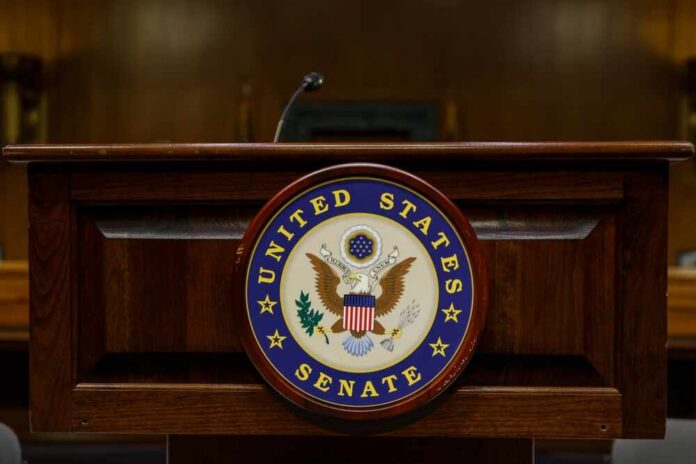
Senate Democrats tried to slam the brakes on President Trump’s Iran campaign—and Senate Republicans refused, keeping wartime authority in the commander-in-chief’s hands as missiles still fly.
Quick Take
- Senate Republicans defeated a Democratic-led war powers resolution, 47-53, that would have required congressional approval for further military action against Iran.
- The vote showed near party-line alignment, with Sen. Rand Paul backing the resolution and Sen. John Fetterman opposing it.
- Republican leaders argued the measure would signal weakness and hinder the mission to destroy Iran’s nuclear capabilities.
- Democrats framed the vote as a constitutional check meant to prevent another “forever war,” while the conflict expands with no public exit plan.
Senate Rejects War-Powers Brake as Conflict Accelerates
Senators voted 47-53 to block a resolution designed to require Congress to approve additional U.S. military action against Iran. The vote came days after the conflict began with a surprise U.S. attack on Saturday, March 1, 2026, and while lawmakers were being pressed to take a public position on Trump’s war policy. Republicans largely held together, arguing the measure would constrain action during active hostilities.
Sen. Tim Kaine led the push for the war powers vote, arguing that major combat decisions risking American lives should not proceed without congressional authorization. Democratic leaders framed the roll call as a stark choice between restoring constitutional checks and allowing open-ended operations. Republicans countered that the timing mattered, and that forcing restrictions mid-conflict could undermine U.S. leverage and troop safety.
GOP Message: Finish the Mission, Then Debate the Paperwork
Republican senators emphasized speed and clarity of purpose, with Sen. Joni Ernst underscoring urgency by saying, “The sooner the better,” as she pointed to the human cost of war, including an Iowa soldier killed early in the conflict. GOP leadership also argued Democrats were focused on procedural obstruction rather than the stated objective of neutralizing Iran’s nuclear program and related military capabilities.
Sen. Susan Collins opposed the resolution on the grounds that it could send the wrong signal to Iran and to U.S. forces in the field. Senate Republican Whip John Barrasso pressed the view that Democrats were prioritizing political confrontation over operational success. In the House, GOP leaders echoed that line, warning that imposing new constraints could “kneecap” U.S. forces during an ongoing, volatile regional fight.
Notable Crosscurrents: Rand Paul and John Fetterman Break Ranks
The vote was not perfectly partisan. Sen. Rand Paul was the lone Republican to vote for the resolution, aligning with the argument that Congress must authorize wars beyond immediate defense. On the Democratic side, Sen. John Fetterman voted against the measure. Those defections mattered because they highlighted the real tension inside both parties: balancing constitutional war powers, deterrence, and the political consequences of backing or opposing a president in wartime.
War Scope, Unclear End State, and an Eight-Week Estimate
Reports indicated the conflict had already expanded across the Middle East, with Iranian missile capabilities still relevant even as U.S. operations sought control of the battlespace. Defense Secretary Pete Hegseth projected the war could extend about eight weeks, and President Trump publicly left open the possibility of ground troops. The administration also sought congressional backing after launching the campaign, a sign the political battlefield matters alongside the military one.
What Congress Does Next in the House Will Shape the Precedent
House lawmakers debated related measures the day after the Senate vote, including a GOP resolution emphasizing Iran’s role as a state sponsor of terrorism and a separate bipartisan war powers effort associated with Reps. Ro Khanna and Thomas Massie. The immediate impact of the Senate vote is straightforward: it leaves Trump’s operational flexibility intact. The longer-term impact is broader, because each war-powers fight sets expectations about when Congress will—or won’t—try to reassert its authority.
Senate Republicans On Iran War Ending: Sooner The Better https://t.co/I4sKoOMG2d
— zerohedge (@zerohedge) March 13, 2026
For voters who are weary of endless overseas entanglements but also demand strength against regimes that sponsor terrorism, the central issue is not slogans—it is clarity. The available reporting does not provide a detailed public exit strategy, and it does not quantify costs or timelines beyond Hegseth’s estimate. With that limited data, the hard fact remains: Republicans chose unity behind Trump’s war posture for now, while Democrats tested constitutional leverage and lost.
Sources:
Senate Republicans vote down legislation to halt Iran war in Congress’ first vote on the conflict
Senate vote: Democrats’ Iran war powers resolution