President Trump signs executive order imposing federal controls on mail-in voting, igniting fears of executive overreach that could upend state election powers and the constitutional balance ahead of midterms.
Story Highlights
- Trump’s March 31, 2026, order mandates USPS bar-coded envelopes and federal voter lists to curb alleged mail-in fraud.
- Federal agencies like DHS and Social Security must compile citizen eligibility lists, threatening non-compliant states with funding cuts.
- Critics, including California officials and attorney Marc Elias, vow immediate lawsuits claiming unconstitutional intrusion on state authority.
- Nearly 50 million Americans used mail-in voting in 2024; new rules risk disrupting access for military, disabled, and rural voters.
- Administration defends move as essential for election integrity, echoing GOP’s SAVE America Act.
Executive Order Details
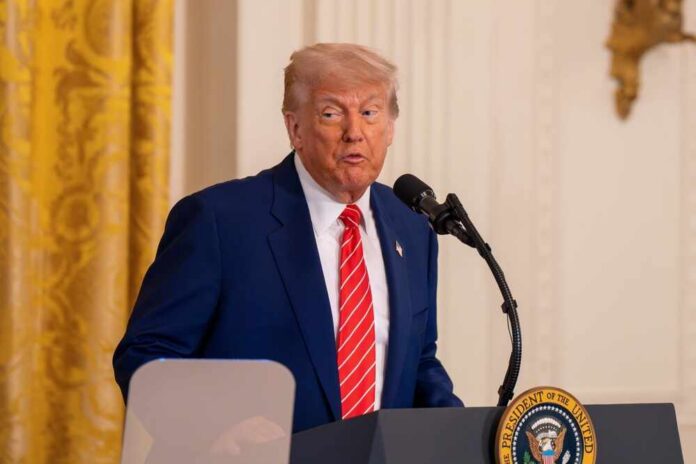
President Donald Trump signed the executive order on March 31, 2026, directing the U.S. Postal Service to implement special bar-coded envelopes for tracking mail-in ballot distribution and returns. Federal agencies, including the Department of Homeland Security, U.S. Citizenship and Immigration Services, and Social Security Administration, must compile lists of verified U.S. citizens aged 18 or older with state residency. The USPS cannot transmit ballots lacking matches to these approved lists. Attorney General Pam Bondi received orders to probe wrongful ballot distributions. Non-compliant states face federal funding withholding. Trump described the measure as combating massive cheating in mail-in voting.
Administration’s Defense and Trump’s Stance
Trump dismissed potential legal challenges, asserting the order cannot be contested except by rogue judges and was crafted by great legal minds. Commerce Secretary Howard Lutnick defended it as ensuring mail-in ballots remain safe, secure, and accurate. The Republican Party backs the restrictions as vital for election security, aligning with the House-passed SAVE America Act requiring citizenship proof for voter registration. This escalates Trump’s long campaign against mail-in voting, despite his own recent use of mail-in ballots in Florida. Supporters view it as upholding integrity against past fraud claims from 2020.
Opposition and Legal Challenges
Democratic election attorney Marc Elias threatened swift legal action, declaring the order unconstitutional and stating he does not bluff. California leaders promised to block it in court, citing prior successes against similar Trump orders. The Brennan Center for Justice argues the Constitution assigns federal election powers to states and Congress, not the president, labeling this an illegal power grab for partisan ends. Election experts dismiss Trump’s fraud claims as unfounded, noting a decade of court rejections. States prepare for federal interference disrupting established systems.
Immediate court battles loom, with precedents showing blocks on past orders. Three courts ruled states need not share voter files, and a DC court found presidential overreach on voter registration laws. Experts highlight misinterpretation of Election Day statutes, which govern vote casting, not receipt.
Potential Impacts on Voters and Elections
Nearly 50 million voters relied on mail-in ballots in 2024, including military personnel, disabled individuals, and those in remote areas. The order risks disenfranchising these groups through untested federal tracking and list-matching. State election officials face new federal mandates complicating administration ahead of November 2026 midterms. Long-term, it could shift power from states to the executive, eroding federalism—a core conservative principle limiting government overreach. Public trust in elections may suffer if implementation falters, regardless of intent.
Partisan effects favor Republicans, as Democrats depend more on mail-in voting. Conservatives wary of federal expansion must weigh fraud prevention against state sovereignty erosion. Outcomes hinge on courts preserving constitutional limits on executive power.
Sources:
POLITICO: Trump Signs Executive Order Limiting Mail-In Voting Ahead of Midterm Elections
Bloomberg: Trump to Sign Order to Curb Mail-In Ballots
Brennan Center for Justice: Status of Trump’s Anti-Voting Executive Order
U.S. Senate Records: Padilla Statement on Trump’s Illegal Election Takeover Executive Order
White House: Preserving and Protecting the Integrity of American Elections