
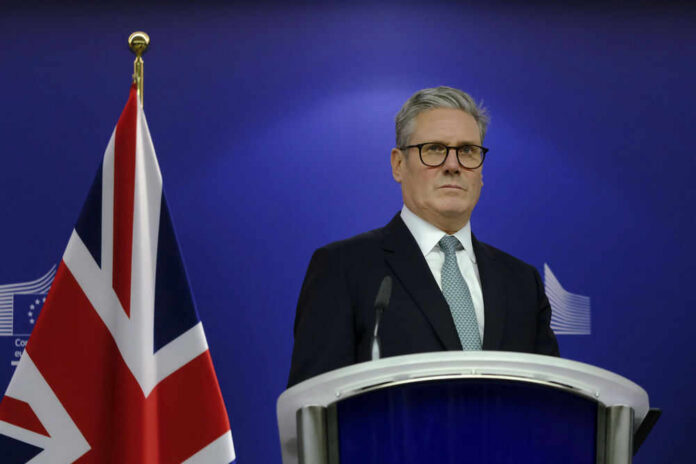
President Trump’s blunt message to Britain’s prime minister—don’t show up after the hard fighting is done—has exposed a widening crack in the “special relationship” during a live war with Iran.
Quick Take
- President Trump criticized U.K. Prime Minister Keir Starmer over Britain’s limited role in the U.S.-Iran conflict and suggested late support would carry little value.
- Starmer told Parliament the U.K. did not join the initial U.S.-Israeli strikes and would not join offensive U.S. operations, while still providing defensive help.
- The dispute centers on how and when the U.S. can use sensitive U.K.-linked bases, including Diego Garcia and RAF Akrotiri in Cyprus.
- Iran’s missile-and-drone retaliation widened the conflict across the Gulf and hit a U.K. base, pushing London toward tighter “defensive” cooperation.
Trump’s Warning Signals a Harder Line on Allied Burden-Sharing
President Trump’s reported remark to Starmer—“we don’t need people that join wars after we’ve already won”—landed as more than a personal jab. It underscored Washington’s demand that allies either commit early or accept reduced influence later. POLITICO described Trump privately and publicly airing frustrations with European partners, including Britain, and tying cooperation to access for key facilities used in U.S. operations.
Trump’s broader comments also placed the U.K. dispute inside a wider pattern of pressure on allies. The reporting highlighted complaints about Britain being “very, very uncooperative” over Diego Garcia, along with language contrasting today’s leaders with Churchill-era resolve. For American voters weary of global freeloading, the immediate takeaway is clear: the White House wants real burden-sharing, not symbolic statements after U.S. forces have carried the load.
Starmer Draws a Bright Line: Defensive Cooperation, Not Offensive Strikes
Prime Minister Starmer’s March 2 statement to the House of Commons set formal limits on U.K. participation. Starmer said Britain was not involved in the initial U.S.-Israeli strikes and would not join offensive U.S. strikes. He framed the U.K. approach around collective self-defense, protection of British lives, and a longstanding goal of preventing Iran from obtaining a nuclear weapon through a negotiated framework, while stressing lessons learned from past conflicts.
Starmer also described an operational posture that still supports allies under attack. He said British Typhoons and F-35s were already participating in defensive coalition missions and had intercepted multiple threats, including drones heading toward a coalition base in Iraq housing U.K. personnel. That distinction—defensive interceptions versus offensive strikes—matters in U.K. domestic politics, but it also shapes what the U.S. can reasonably expect from London when American forces are actively engaged.
Base Access Becomes the Real Flashpoint in a Fast-Moving War
The argument is not only about rhetoric; it is about geography and capability. Diego Garcia and RAF Akrotiri sit at the crossroads of U.K. sovereignty and U.S. power projection. POLITICO reported the U.S. president’s irritation over limits tied to Diego Garcia, while Starmer’s statement emphasized that any U.S. use of British bases would be for a specific, limited defensive purpose. In practical terms, basing rules decide response speed, sortie generation, and deterrence credibility.
The war’s pace is also complicating political messaging. Starmer told Parliament Iran launched hundreds of missiles and drones at multiple regional states, including several Gulf countries that did not attack Iran, and he described additional Hezbollah attacks on Israel. Starmer also said an Iranian drone struck RAF Akrotiri in Cyprus and argued the base had not been used for U.S. offensive strikes at the time, adding that the drone was launched before the latest U.K. defensive announcement.
Rhetoric vs. Reality: “We’ve Already Won” Meets Ongoing Retaliation
Trump has publicly presented the campaign as nearing completion. In remarks highlighted in a YouTube clip of his comments, Trump praised the opening “Midnight Hammer” strike and spoke about “finishing the war against Iran,” while calling on Iranian security forces to lay down their arms. That messaging projects confidence and deterrence, but it can also collide with visible ongoing attacks across the region described by the U.K. government and continuing defensive operations.
The gap between “war nearly finished” rhetoric and continued missile-and-drone threats is where alliance management gets difficult. Starmer’s approach suggests London is trying to keep escalation bounded by defining a narrow legal mission set, while still protecting U.K. personnel and allies under fire. Trump’s criticism suggests Washington is measuring allies by speed and practical contribution, not by carefully worded limits—especially when American forces are absorbing the political and military risk.
What This Means for U.S. Interests—and Why Voters Should Watch the Baseline Rules
The most concrete takeaway is that basing and rules-of-engagement, not press conferences, will determine how effectively the coalition can suppress Iranian launches and protect Americans and partners. Starmer said the U.K. published a summary of its legal position for defensive actions and authorized limited U.S. base use tied to defensive purposes. Those constraints can preserve British domestic support, but they also create friction when U.S. planners want maximum flexibility in a rapidly changing fight.
Iran-US war latest: Trump tells Starmer ‘we don’t need people that join wars after we’ve already won’ | The Independent https://t.co/qwDqDXeCff
— Foxylabour1 (@Foxylabour) March 7, 2026
For Americans who value a strong, constitutional republic that defends its people without being endlessly lectured by global elites, the moment is a reminder: allies can be indispensable, but they also negotiate every step. Trump’s public pressure campaign appears designed to force clarity—who is in, who is out, and under what terms—while the conflict remains active. The available sources do not provide full operational details on U.S. requests or U.K. denials, so the public record still leaves key specifics unresolved.
Sources:
https://www.gov.uk/government/speeches/prime-ministers-oral-statement-on-iran-2-march-2026