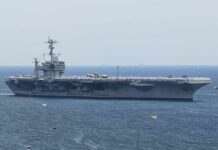
A U.S. Navy strike that killed three Indian sailors off Oman is now fueling a diplomatic storm that could reshape how America fights Iran’s oil smuggling — and how safe global energy routes really are.
Story Snapshot
- India has formally demanded that the United States stop attacks on commercial ships after three Indian sailors were killed in a U.S. strike on the tanker Settebello off Oman.[1][2]
- U.S. Central Command says the Palau-flagged tanker was carrying Iranian oil and repeatedly ignored orders to stop, so a precision strike disabled its engine room.[1][2]
- India, a key U.S. partner, is protesting the deaths, focusing on crew safety and freedom of navigation, while the ship’s manager flatly denies any link to Iranian oil.[1][2]
- The strike is part of a wider U.S. blockade effort against Iran’s oil trade that has already disabled multiple tankers, raising big questions about rules of engagement and global shipping risks.[1][2]
What Happened To The Indian-Crewed Tanker Off Oman
The clash began when a Palau-flagged oil tanker called the Settebello was struck in the Gulf of Oman, roughly off the coast of Oman near key routes into the Strait of Hormuz.[1][2] The tanker carried 28 crew members, including 24 Indians, when a U.S. aircraft hit its engine room with precision weapons.[2][4] U.S. Central Command says the crew had “repeatedly failed to comply” with orders from American forces before the strike, and that the ship was violating a U.S. blockade by attempting to move oil from Iran.[1][2]
Omani forces and rescuers evacuated most of the crew after the blast, but three Indian sailors were first listed as missing and later confirmed dead.[1][2][4] India’s shipping minister named the dead as Aditya Sharma, Shivanand Chaurasiya, and Patnala Suresh, calling their loss a deep tragedy for the maritime community.[2][4] Indian officials say 21 other Indian crew members survived and were taken to safety, while families at home now demand answers on why their loved ones were caught in a U.S. military action.[2][4]
India’s Strong Protest And Demand To End Ship Attacks
New Delhi responded by summoning the United States chargé d’affaires, Jason Meeks, and issuing a formal diplomatic protest over the strike.[1][3][4] India’s foreign ministry said it conveyed its “deepest concerns over the ongoing attacks” on commercial vessels and stressed that freedom of navigation and the safety of Indian seafarers must be protected.[1][3] Officials underlined that three U.S. strikes this week have hit tankers with Indian crew, including the Settebello, and warned that such incidents risk dangerous escalation in an already tense region.[1][4]
India’s message to Washington was simple and blunt: these attacks on ships “must cease and end.”[1] Indian media and diplomats framed the event as a civilian casualty case, not just a sanctions story, highlighting that the crews were working sailors, not combatants.[3][4] At the same time, India has not publicly released radio logs or cargo papers, so its protest rests mainly on humanitarian grounds and the principle of safe passage, rather than a point-by-point rebuttal of the United States military’s claims about warnings and Iranian oil cargo.[1][3][4]
Washington’s Blockade Strategy And The Tanker War With Iran
The Settebello strike did not happen in isolation; it is part of a broader U.S. campaign to choke off Iran’s oil exports in the Gulf of Oman and nearby waters.[1][2] Central Command says it has redirected or disabled dozens of tankers since April under what it describes as an ongoing blockade of Iranian ports and associated vessels.[1] This week alone, U.S. forces say they disabled two other tankers with Indian crew — the Palau-flagged Marivex and the Guinea-Bissau-flagged Jalveer — for trying to move Iranian oil or sail to Iranian ports.[1][2][4]
In these operations, the United States military has shifted from boarding ships to using fighter jets and precision munitions to hit engine rooms, stacks, or funnels, designed to stop a ship without sinking it.[2] Supporters argue this method limits long, risky seizures at sea and reduces the chance of Iranian forces grabbing ships first. Critics point out that even “disabling” strikes can still kill or injure civilian crew members, as seen with the three dead Indian sailors, and may push insurance rates and energy prices higher as ship owners avoid a growing war zone.[1][2]
Dispute Over Iranian Oil, Proof, And Crew Warnings
Central Command claims the Settebello was “attempting to transport oil from Iran” and that its crew ignored repeated directions from American forces before the strike.[1][2] That fits a pattern in recent months, where U.S. statements describe targeted vessels as noncompliant and Iran-linked, then justify action under sanctions enforcement and blockade rules.[1] However, the public record so far does not include the direct Central Command strike packet, radio recordings, or navigation data that would show exactly what warnings were sent or how the ship reacted.[1][2]
Deeply devastated by the tragic news from the Gulf of Oman. Three innocent Indian civilian seafarers — Patnala Suresh, Shivanand Chaurasiya, and Aditya Sharma — have lost their lives following a targeted US precision military strike on the commercial oil tanker, M/T Settebello.…
— Shashi Tharoor (@ShashiTharoor) June 11, 2026
The ship’s manager, IOS Marine FZE, has strongly denied carrying Iranian crude or defying lawful orders, saying the Settebello “holds no affiliation whatsoever with Iran or Iranian oil.”[1] The company has called for a transparent international investigation, including cargo manifests, charter contracts, and insurance records.[1] India, for its part, has focused on the human cost and broader de-escalation, but has not yet presented its own technical evidence on cargo or communications, leaving a gap between U.S. operational claims and the humanitarian anger driving Indian public opinion.[1][3]
Why This Matters For American Power, Energy Security, And Our Values
For American readers, this story is about more than a foreign protest; it is about how the United States uses force in a vital energy corridor and how that choice affects allies, oil prices, and our reputation for rule of law.[1][2] The Persian Gulf and Gulf of Oman are already at a “critical” threat level, with Iran carrying out its own indiscriminate attacks on commercial ships using missiles, drones, and explosive boats. When U.S. strikes also start hitting foreign-crewed tankers, even in the name of sanctions, partners like India will push back hard.
The Trump administration now faces a careful balancing act: keep pressure on Iran’s regime and its oil lifeline, while proving to allies and the world that U.S. forces follow clear rules, respect civilian life, and do not hide the evidence behind their decisions.[1][2] That means declassifying what can be safely shared about warnings, cargo, and legal authority, and working with friendly nations so sailors are not treated as expendable in someone else’s blockade. For conservative Americans who value strong defense and limited government, demanding that level of honesty and restraint from our own bureaucracies is not weakness; it is basic constitutional accountability.
Sources:
[1] Web – India Demands End to U.S. Ship Attacks After 3 Sailors Killed
[2] Web – May 26, 2026: CENTCOM: U.S. Defensive Strikes Against IRGC …
[3] Web – Lethal Kinetic Strike, June 3, 2026 – southcom
[4] Web – CENTCOM launches new strikes against ISIS targets in Syria