
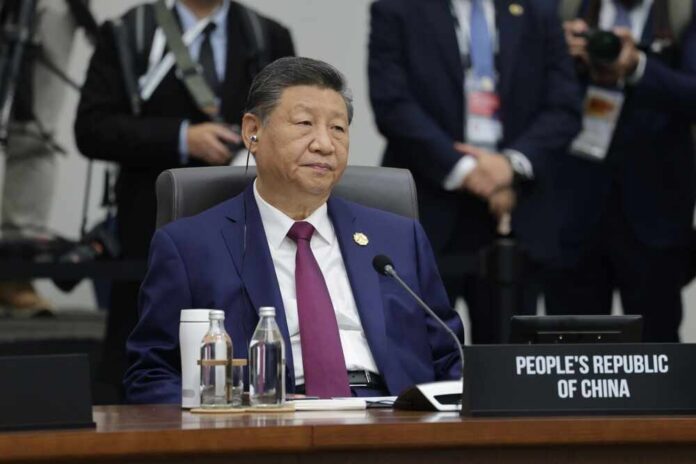
China’s ruler Xi Jinping is openly vowing to build a “world‑class” war machine and purge his generals, while America’s enemies watch for any opening to challenge US power.
Story Snapshot
- Xi Jinping is reshaping China’s military for high‑tech war and total loyalty to the Communist Party.
- Beijing’s long‑term plan is to turn the People’s Liberation Army into a “world‑class” force by 2049.
- Xi is using corruption purges and “political rectification” to tighten his personal grip on the armed forces.
- Deep problems and lack of transparency inside China’s military create both dangers and openings for the United States.
Xi’s push for a ‘world‑class’ war machine
Chinese President Xi Jinping has spent more than a decade turning the People’s Liberation Army into a modern, high‑tech force that can fight and win wars on China’s terms. A formal blueprint approved in 2016 set three big milestones, aiming first for basic modernization by 2020, deeper transformation by 2035, and full “world‑class” status by 2049. That long timeline matters for Americans, because it shows this is not a short surge but a steady, strategic build‑up meant to reshape the balance of power.
In April 2024, Xi announced a new information‑focused restructuring, creating an Information Support Force to help China gain “information dominance” and coordinate joint operations across land, sea, air, space, and cyber. This step fits a clear pattern: China is not just buying more tanks and ships, it is trying to knit them together into a digital war machine that can track and strike targets quickly. For US allies near China, that raises hard questions about how long they can safely depend on old command and control systems.
Absolute party control and the purge of China’s generals
Xi’s power over the military runs through the Central Military Commission, where a special “chairman responsibility system” gives him final say on all key decisions. That system was written into the Communist Party’s rules in 2017, locking in Xi as the top man in charge of the gun. For Americans who value civilian control but also checks and balances, this is a reminder that in China, one leader can wield unified control over nuclear forces, cyber units, and massed conventional troops without open debate.
Since taking power in 2012, Xi has launched a vast anti‑corruption campaign that hits not only civilian officials but also senior generals. Recent years have seen defense ministers and top commanders removed and prosecuted for “severe corruption” and “polluting” the armed forces. Military documents now stress “political rectification,” which means both fighting graft and enforcing ideological loyalty to Xi and the party. As Xi himself put it, “the barrels of guns must always be in the hands of those who are loyal and dependable to the party.”
Deep problems inside the PLA: risk and opportunity
Despite the tough talk, Xi admits the army still faces “deep‑seated problems” in its politics, ideology, work style, and discipline. State media quotes him calling for new tools to punish hidden forms of corruption and for stronger oversight of senior officers. Analysts point out that such purges and political campaigns can slow real military learning, because commanders worry more about pleasing the leader than about honest training reports. This may make China’s armed forces look strong on paper while hiding serious weaknesses.
Chinese President Xi Jinping emphasized the urgent need to fast-track the modernization of the nation's armed forces, asserting that China must expedite the development of a world-class military to effectively protect its national sovereignty and strategic interests. pic.twitter.com/2WPGfBmJih
— Bakhtar News Agency (@bnaenglish) July 1, 2026
For the United States and its allies, China’s mix of rapid modernization and deep internal problems is a double‑edged sword. On one side, Beijing’s growing nuclear arsenal, long‑range missiles, and advanced ships clearly expand its ability to threaten Taiwan and push US forces farther from Asia. On the other side, relentless purges and one‑man control can create brittle chains of command, slow reactions in a crisis, and raise the odds of bad decisions if Xi ever misreads a situation.
What this means for American security and values
Xi’s vow to build a powerful, loyal military matters for American conservatives who care about a strong defense, secure borders, and protection of our way of life. China’s leaders present their build‑up as “peaceful development,” but they tightly control information about real budgets, capabilities, and exercises. That lack of transparency fuels a regional arms race, as countries like Japan respond with record defense spending and new strategies aimed squarely at China’s expansion. It also means US planners must prepare for worst‑case scenarios.
At the same time, Xi’s model of absolute party control over the gun is the exact opposite of the constitutional system Americans cherish. His purges show how authoritarian regimes use the military not just to deter foreign threats, but to lock down power at home. For US readers, the lesson is clear: we need to keep our own military strong, ethical, and firmly under constitutional control, even as we invest in advanced technology and stockpiles. A free nation cannot afford to ignore a rising power whose leader is openly reshaping his forces for information‑age warfare and tighter one‑man rule.
Sources:
insiderpaper.com, ndupress.ndu.edu, swp-berlin.org, isdp.eu, facebook.com, instagram.com, uscc.gov, airuniversity.af.edu, reddit.com, ecommons.cornell.edu, caitlintalmadge.com, annualreviews.org, repositori.upf.edu